
IAE Academy

GATE 2026 EE Q.19: solution and answer

GATE 2026 · EEQ.19 · 1 mark · MCQ

The initial three-phase voltage phasors (V_A, V_B and V_C) at a bus of a power network are as shown in Case-1. Due to a disturbance, the bus voltage phasors changed in phase by a small angle Δθ, and the magnitudes remained the same as depicted in Case-2.

Which one of the following statements is correct about the zero sequence components?
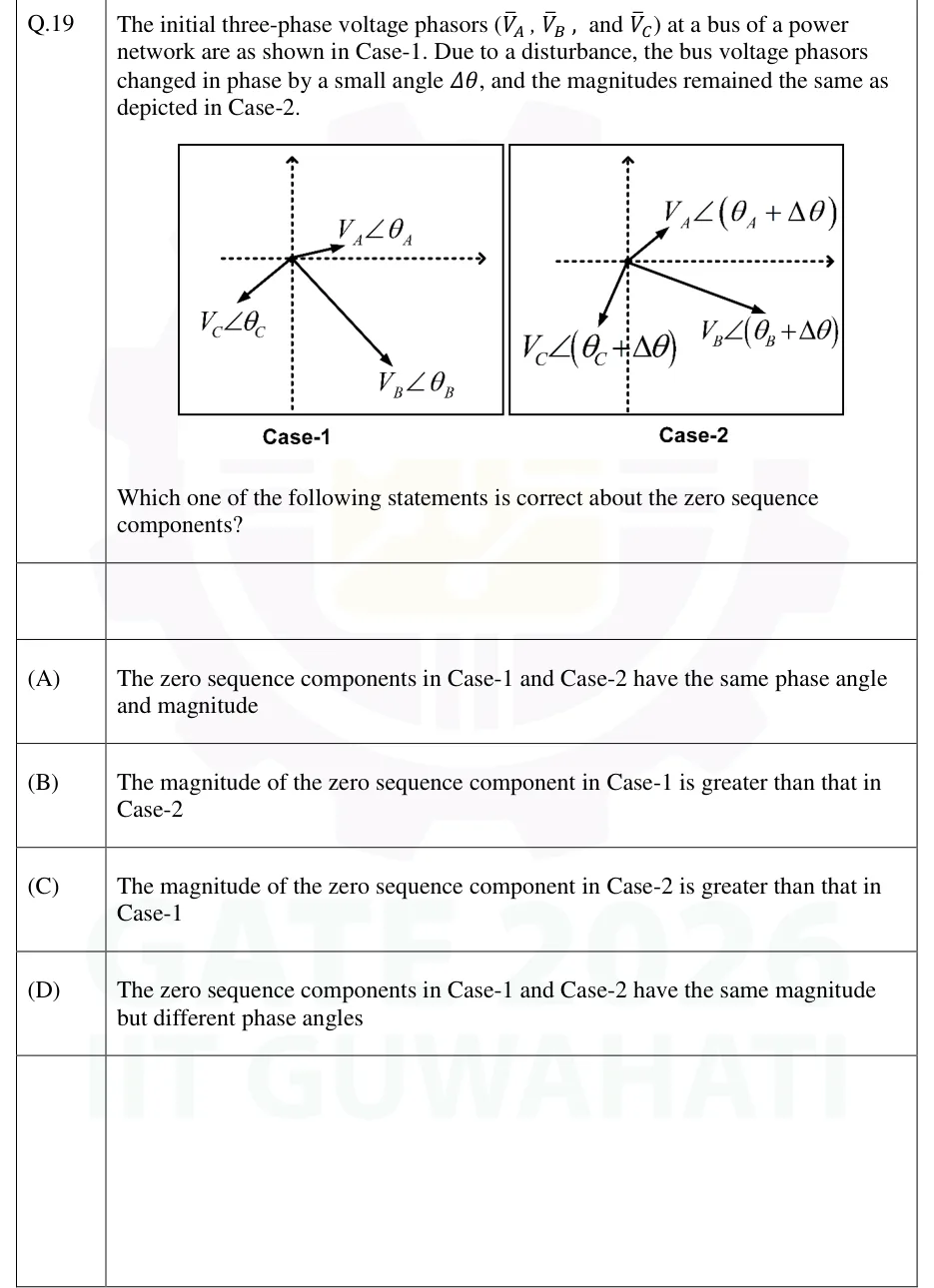
GATE 2026 EE question 19: Two boxed phasor diagrams, Case-1 and Case-2, each with a horizontal dashed real axis and a vertical dashed imaginary axis…Tap to open full size
Figure from the GATE 2026 EE paper. It is part of the question.
Figure description

Two boxed phasor diagrams, Case-1 and Case-2, each with a horizontal dashed real axis and a vertical dashed imaginary axis through the origin. Case-1: V_A at angle θ_A points up and to the right (shortest arrow, upper right); V_B at angle θ_B points down and to the right (longest arrow, lower right); V_C at angle θ_C points down and to the left (lower left). Case-2: the same three phasors with the same lengths, each rotated by the same small angle Δθ: V_A at angle (θ_A + Δθ) in the upper right, V_B at (θ_B + Δθ) in the lower right (rotated anticlockwise, so flatter), V_C at (θ_C + Δθ) in the lower left (rotated anticlockwise, so steeper). Magnitudes V_A, V_B, V_C are unchanged.

  1. (A)

    The zero sequence components in Case-1 and Case-2 have the same phase angle and magnitude

  2. (B)

    The magnitude of the zero sequence component in Case-1 is greater than that in Case-2

  3. (C)

    The magnitude of the zero sequence component in Case-2 is greater than that in Case-1

  4. (D)

    The zero sequence components in Case-1 and Case-2 have the same magnitude but different phase angles

Answer and solution

ANSWER

Option (D): the zero sequence components in Case-1 and Case-2 have the same magnitude but different phase angles.

Official answer: DSource: Official answer key, GATE 2026 EE (IIT Guwahati)

  1. The zero sequence component is the average of the three phase voltages: .

  2. Case-1: . From the figure, points slightly above the real axis while and both point below it, and is the longest phasor. The sum of the imaginary parts is therefore negative, so . A nonzero has a definite magnitude and a definite angle.

  3. Case-2: every phasor keeps its magnitude and its angle is increased by the same . Each phasor is therefore multiplied by .

  4. Hence .

  5. Multiplying by rotates a phasor without changing its length, so . The magnitudes are equal, which rules out options (B) and (C).

  6. The angle of is the angle of plus . Since (and ), the phase angles differ. This rules out option (A).

  7. The zero sequence components have the same magnitude but different phase angles, which is option (D).

KEY IDEA

The zero sequence component is the plain average of the three phase phasors. Turning all three by the same angle turns their sum by that angle and leaves its length unchanged.

WATCH OUT FOR

Thinking that a change in the phase angles must change the size of the zero sequence component. A common rotation changes only its angle. Another slip is to assume the average is zero without checking that the phasors in the figure are unbalanced.

From the GATE 2026 EE paper. Every question of this paper · Download the full paper · All 8 Faults questions, with notes

More Faults questions