IAE Academy

GATE 2023 EE Q.21: solution and answer

GATE 2023 · EEQ.21 · 1 mark · MCQ

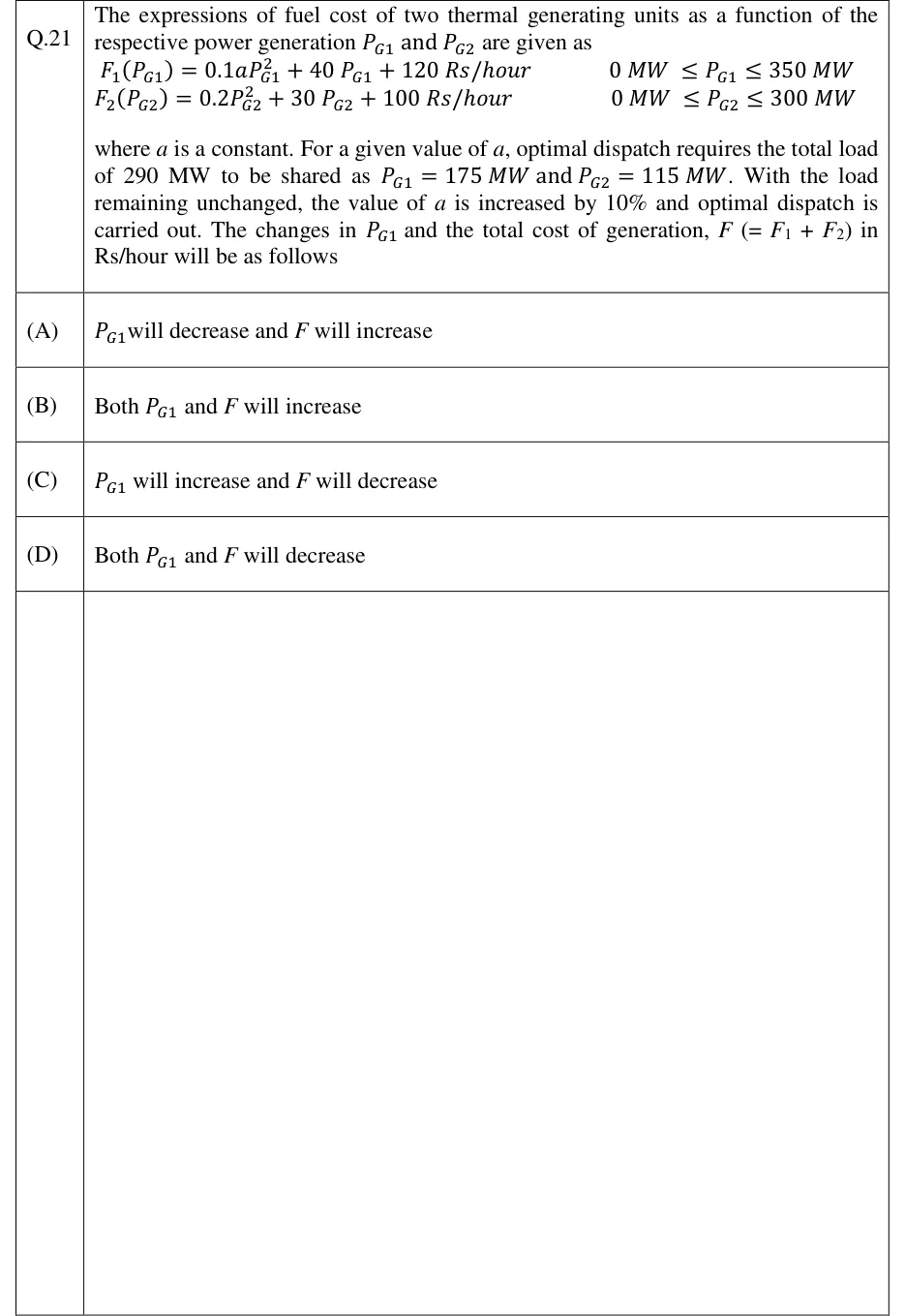
The expressions of fuel cost of two thermal generating units as a function of the respective power generation P_G1 and P_G2 are given as
F_1(P_G1) = 0.1 a P_G1^2 + 40 P_G1 + 120 Rs/hour, 0 MW ≤ P_G1 ≤ 350 MW
F_2(P_G2) = 0.2 P_G2^2 + 30 P_G2 + 100 Rs/hour, 0 MW ≤ P_G2 ≤ 300 MW
where a is a constant. For a given value of a, optimal dispatch requires the total load of 290 MW to be shared as P_G1 = 175 MW and P_G2 = 115 MW. With the load remaining unchanged, the value of a is increased by 10% and optimal dispatch is carried out. The changes in P_G1 and the total cost of generation, F (= F_1 + F_2) in Rs/hour will be as follows

  1. (A)

    P_G1 will decrease and F will increase

  2. (B)

    Both P_G1 and F will increase

  3. (C)

    P_G1 will increase and F will decrease

  4. (D)

    Both P_G1 and F will decrease

See the question in the paper

Answer and solution

ANSWER

P_G1 will decrease and F will increase (option A).

Official answer: ASource: Official answer key, GATE 2023 EE (IIT Kanpur)

  1. Incremental costs: and . Both units lie inside their limits, so the optimum has equal incremental cost and .

  2. Original dispatch: . Then , so and .

  3. New value: , so .

  4. New optimum: , so and , . Hence decreases from .

  5. Original cost: and , so .

  6. New cost: and , so , which is higher.

  7. Check by reasoning: raising raises at every positive output, so for any fixed split of the load the cost is higher. The cheapest split under the new therefore costs more than the cheapest split under the old , and increases. Unit 1 is now dearer at the margin, so it is loaded less.

  8. So decreases and increases, which is option (A).

KEY IDEA

Economic dispatch needs equal incremental cost on both units. Find a from the original dispatch, raise it by 10%, and re-solve the equal-lambda condition. A dearer unit 1 is loaded less, and the minimum total cost cannot fall when one cost curve rises.

WATCH OUT FOR

Concluding that the total cost falls because the dispatch is re-optimised. Re-optimising only limits the rise: the new minimum is still above the old one, since F_1 is higher at every output. Another slip is to compare the increase in a with a change in lambda without solving the equations.

From the GATE 2023 EE paper. Every question of this paper · Download the full paper · All 9 Dispatch & control questions, with notes

More Dispatch & control questions