
IAE Academy

GATE 2018 EE Q.31: solution and answer

GATE 2018 · EEQ.31 · 2 marks · MCQ

A DC voltage source is connected to a series L-C circuit by turning on the switch S at time as shown in the figure. Assume . Which one of the following circular loci represents the plot of versus ?
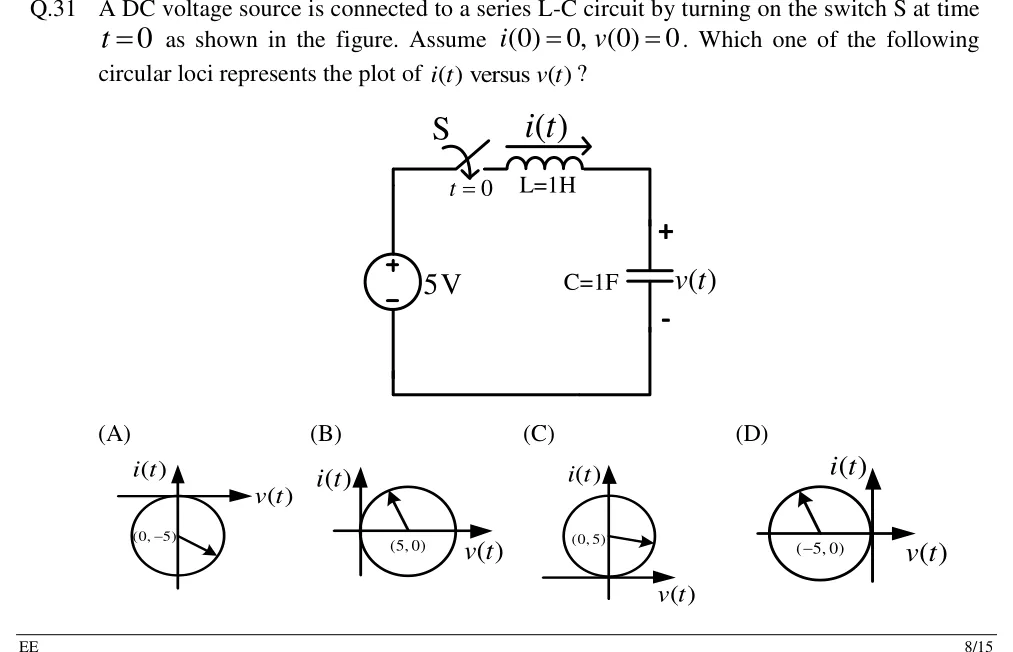
GATE 2018 EE question 31: Single series loop.Tap to open full size
Figure from the GATE 2018 EE paper. It is part of the question.
Figure description

Single series loop. Left branch: a 5 V DC voltage source, + terminal at the top, - at the bottom. From the top of the source the wire goes right through switch S (closes at t = 0), then an inductor L = 1 H; the current i(t) is marked with an arrow pointing rightward (clockwise around the loop) above the inductor. Right branch: capacitor C = 1 F, with its voltage v(t) marked + at the top and - at the bottom. Bottom wire returns from the capacitor to the - terminal of the source. Options are four plots, each with v(t) on the horizontal axis and i(t) on the vertical axis, showing a circle with a radius arrow drawn from its labelled centre: (A) circle centred at (0, -5), lying below the v-axis and touching it at the origin; (B) circle centred at (5, 0), lying to the right of the i-axis and touching it at the origin; (C) circle centred at (0, 5), lying above the v-axis and touching it at the origin; (D) circle centred at (-5, 0), lying to the left of the i-axis and touching it at the origin.

  1. (A)

    Figure — circle of radius 5 centred at in the – plane (below the axis, tangent to it at the origin)

  2. (B)

    Figure — circle of radius 5 centred at in the – plane (right of the axis, tangent to it at the origin)

  3. (C)

    Figure — circle of radius 5 centred at in the – plane (above the axis, tangent to it at the origin)

  4. (D)

    Figure — circle of radius 5 centred at in the – plane (left of the axis, tangent to it at the origin)

Answer and solution

ANSWER

The locus is the circle : radius 5, centred at and touching the axis at the origin. The answer is option (B).

Official answer: BSource: Official answer key, GATE 2018 EE (IIT Guwahati)

  1. Set up the loop equations for . With S closed, the current flows clockwise: out of the source's + terminal, through , and into the + terminal of . That gives the passive sign convention at the capacitor, so . KVL around the loop gives . With and , substitute :

  2. General solution (particular plus natural): .

  3. Apply the initial conditions. gives , so . . Hence

  4. Current: . Check: at , , which agrees with .

  5. Eliminate . From the two results, and . Then gives

  6. Cross-check with energy (the circuit is lossless). Multiply by to get . Integrate from , where and : This is the same circle.

  7. Read off the locus. It is a circle of radius centred at . It passes through the origin at and touches the axis there. Over each cycle, swings from to and from to . This is option (B).

KEY IDEA

A DC step applied to a lossless series LC circuit makes the capacitor voltage oscillate about the source voltage. Here , so the voltage has amplitude 5 V around a centre of 5 V. The current is 90 degrees out of phase with that oscillation, with amplitude . Plotting two quadrature sinusoids against each other gives an ellipse centred at . It is a circle here only because , which makes both amplitudes equal to 5.

WATCH OUT FOR

One mistake is assuming the capacitor charges only up to 5 V, as it would in an RC circuit. With no resistance, it overshoots to 10 V, so the circle is centred at , not at the origin. Another is mixing up the axes (the vertical axis is ) and choosing the circle centred at . A third is a polarity slip that gives the centre . is never negative, so every point of the locus has .

From the GATE 2018 EE paper. Every question of this paper · Download the full paper · All 20 Transients questions, with notes

More Transients questions