IAE Academy

GATE 2026 EC Q.23: solution and answer

GATE 2026 · ECQ.23 · 1 mark · MCQ

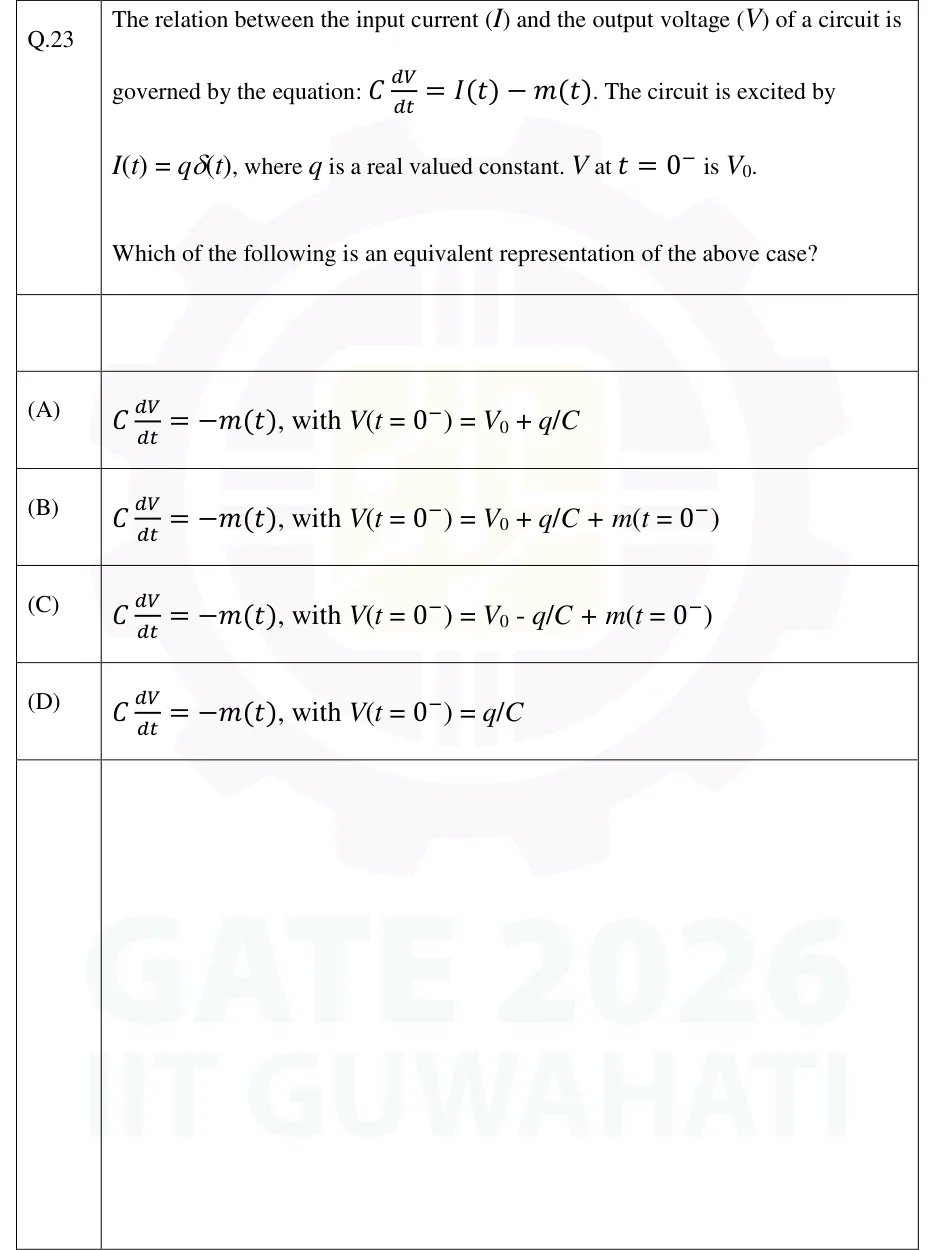
The relation between the input current () and the output voltage () of a circuit is governed by the equation: . The circuit is excited by , where is a real valued constant. at is .

Which of the following is an equivalent representation of the above case?

  1. (A)

    , with

  2. (B)

    , with

  3. (C)

    , with

  4. (D)

    , with

See the question in the paper

Answer and solution

ANSWER

(A) , with

Official answer: ASource: Official answer key, GATE 2026 EC (IIT Guwahati)

  1. Read the equation as KCL at a capacitor node: is the current into a capacitor , is the source current and is the current drawn by the rest of the circuit. The impulse delivers a charge (in ) in zero time.

  2. Integrate both sides across the impulse, from to :

  3. By the sifting property, . The rest of the circuit draws a finite current (the standard assumption, implicit in the question: contains no impulse), and a finite function integrated over an interval of zero width gives .

  4. So the voltage jumps by the injected charge divided by : where is in .

  5. For we have , so the circuit obeys , starting from .

  6. Equivalent picture: remove the impulse source and give the capacitor the initial voltage . With no impulse in this equivalent system, is continuous at , so its value at equals its value at : . This is option (A).

  7. Check in the Laplace domain (initial conditions taken at ). The original equation transforms to Moving to the left: which is exactly the transform of with . Both systems give the same , so they are equivalent.

  8. The other options fail: (B) and (C) add , a current in , to a voltage, which is dimensionally inconsistent; (C) also has the wrong sign on (a positive charge raises the capacitor voltage). (D) drops and is right only when .

KEY IDEA

A current impulse into a capacitor dumps a charge on it instantly, so the voltage jumps by . The impulse can be removed and replaced by the initial condition . In the Laplace domain this is just moving into the initial-condition term: is the same as .

WATCH OUT FOR

Being put off by the label in option (A) and expecting to belong only at . In the equivalent system there is no impulse, so is continuous and its and values are the same. Other traps: picking (B) or (C), which add a current to a voltage (a quick unit check rules them out), or picking (D), which forgets the voltage the capacitor already had.

From the GATE 2026 EC paper. Every question of this paper · Download the full paper · All 20 Transients questions, with notes

More Transients questions