
IAE Academy

GATE 2020 IN Q.34: solution and answer

GATE 2020 · INQ.34 · 2 marks · NAT

In the circuit shown, the rms value of the voltage across the 100 resistor (in volts) is ____.
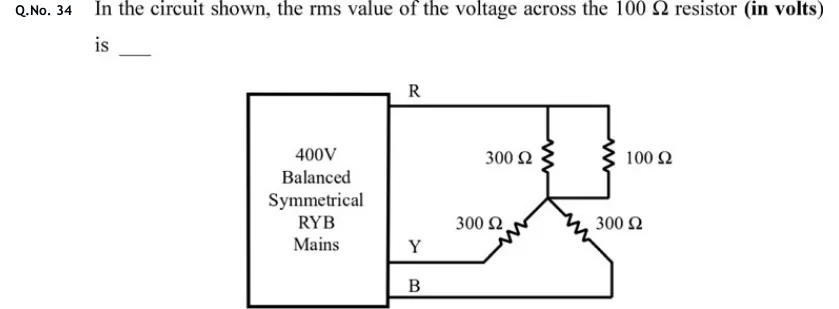
GATE 2020 IN question 34: On the left, a box labelled "400V Balanced Symmetrical RYB Mains" with three output lines on its right side, labelled R…Tap to open full size
Figure from the GATE 2020 IN paper. It is part of the question.
Figure description

On the left, a box labelled "400V Balanced Symmetrical RYB Mains" with three output lines on its right side, labelled R (top), Y (middle) and B (bottom). There is no neutral wire. Line R runs horizontally to the right and connects to the top ends of two vertical resistors placed side by side: 300 Ω (left) and 100 Ω (right). The bottom ends of these two resistors are joined, so the 300 Ω and 100 Ω are in parallel, and this common bottom node connects to a star point. From the star point, a 300 Ω resistor runs diagonally down-left to line Y, and another 300 Ω resistor runs diagonally down-right to line B. The load is therefore an ungrounded star: R arm = 300 Ω ∥ 100 Ω, Y arm = 300 Ω, B arm = 300 Ω.

Answer and solution

ANSWER

The rms voltage across the 100 Ω resistor is about 115.47 V.

Official answer: 115 to 116Source: Official answer key, GATE 2020 IN (IIT Delhi)

  1. Reduce the R arm. The 300 and 100 resistors are both connected between line R and the star point, so they are in parallel: The voltage across the 100 resistor is therefore the whole R-arm voltage .

  2. Source phase voltage. Take 400 V as the line voltage of the balanced supply: . Let (measured from the source neutral ). Because the supply is balanced, , so .

  3. Neutral shift (Millman's theorem at the floating star point ). There is no neutral wire, so (using ).

  4. KVL across the R arm.

  5. Check with a Thevenin equivalent. The Y and B arms are equal, so seen from the star point they reduce to behind a source (the midpoint of the Y–B line voltage). The voltage from R to that point is , i.e. . By the voltage divider:

  6. The rms voltage across the 100 resistor is .

KEY IDEA

In an unbalanced star load with no neutral, the star point floats. Find its shift from the source neutral with Millman's theorem, then subtract it from the phase voltage. Here the R arm is 75 Ω against 300 Ω in each of the other two arms, which puts the star point exactly halfway to V_R, so the R arm gets V_R/2.

WATCH OUT FOR

The usual error is to assume the star point stays at the source neutral and answer 230.94 V (the full phase voltage). That ignores the neutral shift an unbalanced, ungrounded star produces. A second error is to put only part of the arm voltage across the 100 Ω by treating it as in series with the 300 Ω, when the two resistors are actually in parallel.

From the GATE 2020 IN paper. Every question of this paper · Download the full paper · All 11 Three-phase (EE) questions, with notes

More Three-phase (EE) questions