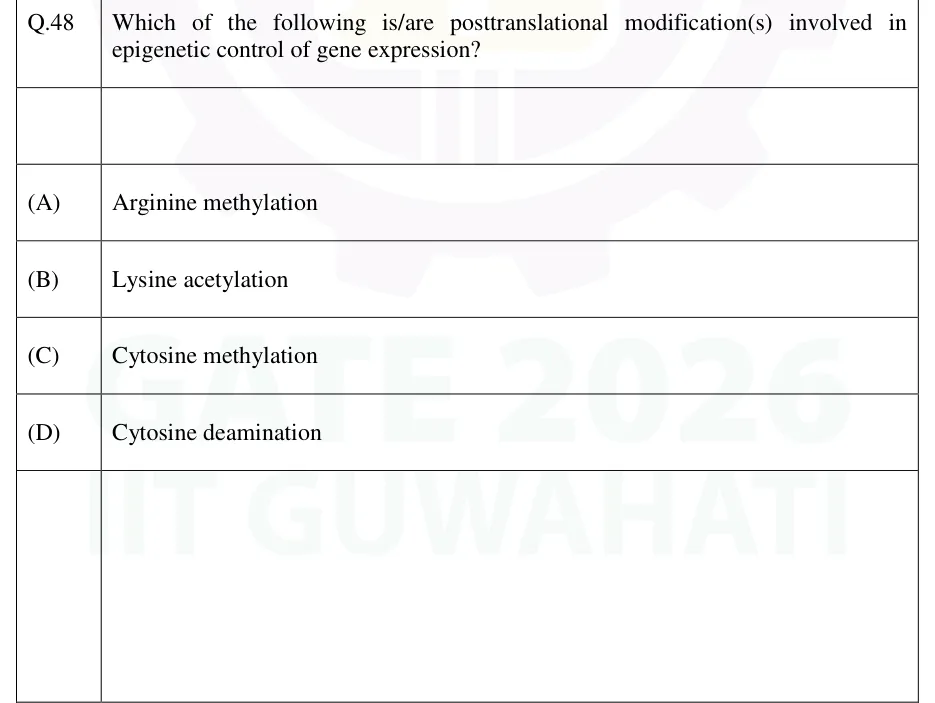
Which of the following is/are posttranslational modification(s) involved in epigenetic control of gene expression?
- (A)
Arginine methylation
- (B)
Lysine acetylation
- (C)
Cytosine methylation
- (D)
Cytosine deamination

Which of the following is/are posttranslational modification(s) involved in epigenetic control of gene expression?
Arginine methylation
Lysine acetylation
Cytosine methylation
Cytosine deamination
ANSWER
Options (A) Arginine methylation and (B) Lysine acetylation are correct.
Official answer: A, BSource: Official answer key, GATE 2026 BT (IIT Guwahati)
Identify the question type: MSQ, 2 marks — select all listed items that are BOTH (i) posttranslational modifications (chemical changes to a protein after it is translated) AND (ii) mechanisms of epigenetic control of gene expression.
Recall that the best-characterized posttranslational modifications used epigenetically are histone tail modifications — methylation, acetylation, phosphorylation, ubiquitination, sumoylation — which alter chromatin structure and gene accessibility without changing the DNA sequence.
(A) Arginine methylation: histone arginine residues (e.g., H3R2, H3R8, H4R3) are methylated by protein arginine methyltransferases (PRMTs). This modifies the histone protein after translation and is an established epigenetic mark that influences transcriptional activity → satisfies both criteria → CORRECT.
(B) Lysine acetylation: histone lysine residues (e.g., H3K9, H3K27, H4K16) are acetylated by histone acetyltransferases (HATs), neutralizing the lysine's positive charge, loosening histone-DNA contacts, and promoting an open, transcriptionally active chromatin state. This is a protein modification occurring after translation and a classic epigenetic mark → satisfies both criteria → CORRECT.
(C) Cytosine methylation: 5-methylcytosine is formed by DNA methyltransferases adding a methyl group directly to cytosine bases in DNA, most often at CpG sites. Although this is a major epigenetic mechanism (typically gene-silencing), it modifies DNA, not a translated protein — so it fails the 'posttranslational modification' requirement of the stem → INCORRECT for this question.
(D) Cytosine deamination: this converts cytosine to uracil (or 5-methylcytosine to thymine) in DNA, a chemical/mutagenic base change usually corrected by DNA repair pathways. It is neither a protein modification nor a recognized epigenetic regulatory mechanism (it is a source of mutation/damage, not gene regulation) → INCORRECT.
Final selection: only (A) and (B) are histone posttranslational modifications that function in epigenetic control of gene expression; (C) and (D) act on DNA rather than protein and are excluded.
KEY IDEA
Posttranslational modifications (PTMs) act on proteins (here, histones) after translation; only histone marks — not chemical changes to DNA bases — qualify as PTMs, even though DNA methylation is also an epigenetic mechanism.
WATCH OUT FOR
Treating "epigenetic" as synonymous with "posttranslational modification" and picking cytosine methylation (C) because it is a well-known epigenetic mark — it modifies DNA, not a protein, so it fails the PTM criterion in the stem even though it is epigenetic.
From the GATE 2026 BT paper. Every question of this paper · Download the full paper · All 7 Cell signalling questions, with notes