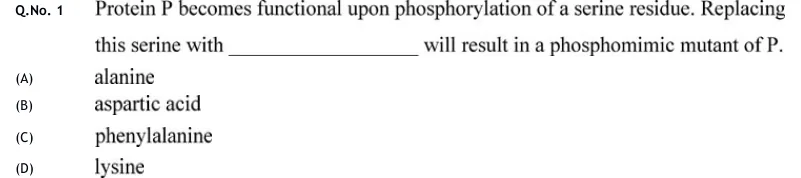
Protein P becomes functional upon phosphorylation of a serine residue. Replacing this serine with ________ will result in a phosphomimic mutant of P.
- (A)
alanine
- (B)
aspartic acid
- (C)
phenylalanine
- (D)
lysine

GENETICS, CELL AND MOLECULAR BIOLOGY · CELL SIGNALLING
Protein P becomes functional upon phosphorylation of a serine residue. Replacing this serine with ________ will result in a phosphomimic mutant of P.
alanine
aspartic acid
phenylalanine
lysine
ANSWER
The answer is (B) aspartic acid.
Official key: B · Official answer key printed with the GATE 2020 BT paper (IIT Delhi)
Phosphorylation of a serine adds a phosphate group to the side chain hydroxyl; at physiological pH this phosphate carries a net negative charge, which activates protein P.
A phosphomimic mutation must reproduce this negative charge constitutively, independent of kinase activity, so the protein behaves as if permanently phosphorylated.
Option A, alanine: small, nonpolar, uncharged, and lacks the hydroxyl needed for phosphorylation. This is the phospho null or phospho dead substitution, used to permanently block phosphorylation, the opposite of a phosphomimic. Not correct.
Option B, aspartic acid: its carboxylate side chain is negatively charged at physiological pH, approximating the charge of a phosphoserine. Aspartate, along with glutamate, is the standard phosphomimetic substitution. Correct.
Option C, phenylalanine: bulky, aromatic, hydrophobic, uncharged; cannot mimic a phosphate group's negative charge. Not correct.
Option D, lysine: positively charged, electrostatically opposite to the phosphate group, so cannot act as a phosphomimic. Not correct.
Hence replacing the serine with aspartic acid (B) creates the phosphomimic mutant, matching the official key.
KEY IDEA
A phosphomimetic substitution replaces the phosphorylatable residue (serine, threonine, or tyrosine) with a residue that is constitutively negatively charged, mimicking the negative charge added by the phosphate group without needing kinase activity.
COMMON MISTAKE
Confusing the phosphomimetic (aspartate or glutamate, mimics the always-on phosphorylated state) with the phospho-null/phospho-dead substitution (alanine, blocks phosphorylation and mimics the always-off unphosphorylated state); these are opposite tools and easy to swap under exam pressure.
From the GATE 2020 BT paper. Every question of this paper · Download the full paper · All 7 Cell signalling questions, with notes