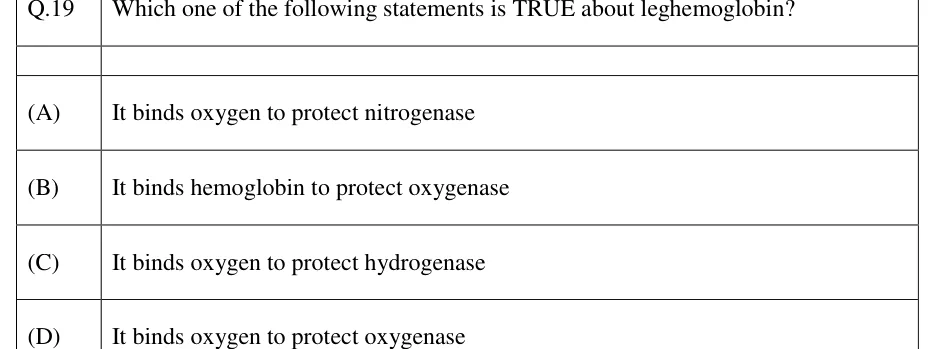
Which one of the following statements is TRUE about leghemoglobin?
- (A)
It binds oxygen to protect nitrogenase
- (B)
It binds hemoglobin to protect oxygenase
- (C)
It binds oxygen to protect hydrogenase
- (D)
It binds oxygen to protect oxygenase

Which one of the following statements is TRUE about leghemoglobin?
It binds oxygen to protect nitrogenase
It binds hemoglobin to protect oxygenase
It binds oxygen to protect hydrogenase
It binds oxygen to protect oxygenase
ANSWER
Leghemoglobin binds oxygen to protect nitrogenase, so the answer is (A).
Official answer: ASource: Official answer key, GATE 2023 BT (IIT Kanpur)
Leghemoglobin is a heme-containing, oxygen-binding protein made in the root nodules of legumes, where rhizobia (as bacteroids) fix nitrogen.
Nitrogenase, which reduces to , is irreversibly inactivated by free , so the nodule interior must keep free very low.
The bacteroids still need for aerobic respiration, which supplies the large ATP demand of nitrogen fixation. Leghemoglobin binds with high affinity, so it holds free low and still delivers to the bacteroid respiratory chain.
Option (A) is correct: leghemoglobin binds oxygen and so protects nitrogenase.
Option (B) is wrong: leghemoglobin binds oxygen, not hemoglobin, and no oxygenase is the protected enzyme.
Option (C) is wrong: the enzyme protected is nitrogenase. Hydrogenase in the nodule only recycles the released by nitrogenase and is not what leghemoglobin protects.
Option (D) is wrong: oxygenases use as a substrate and are not damaged by it, so they need no protection.
KEY IDEA
Nitrogenase is destroyed by free oxygen, but the bacteroids still need oxygen to respire. Leghemoglobin buffers oxygen: it keeps free low and still delivers it to the bacteroids.
WATCH OUT FOR
Confusing leghemoglobin with ordinary hemoglobin, or thinking it protects an oxygenase or hydrogenase. The enzyme it protects is nitrogenase.
From the GATE 2023 BT paper. Every question of this paper · Download the full paper · All 11 Pathogens & antibiotics questions, with notes