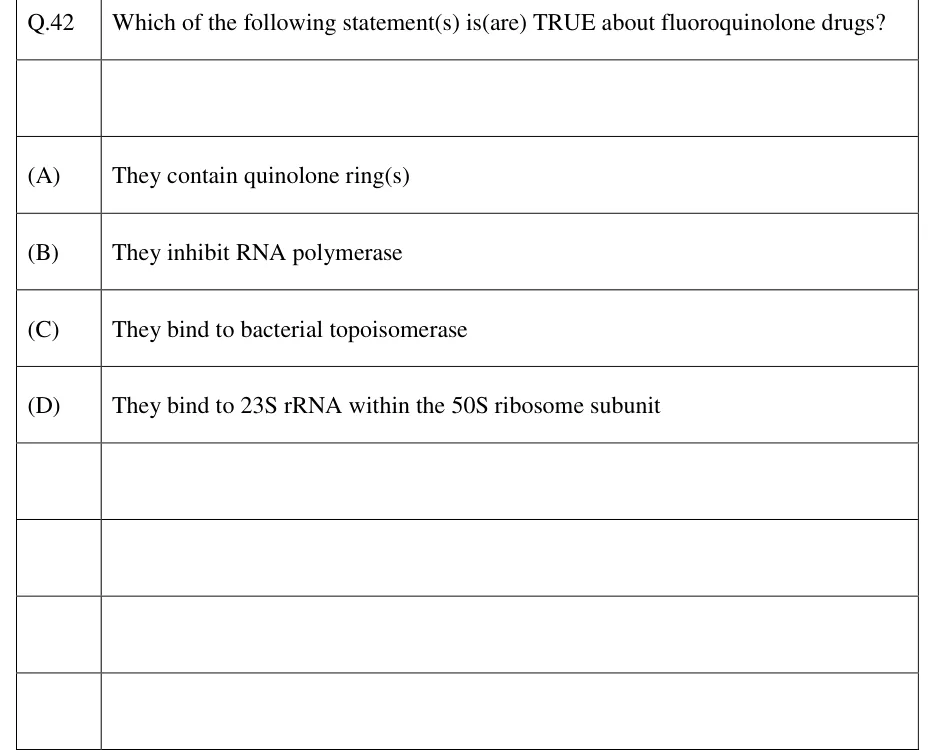
Which of the following statement(s) is(are) TRUE about fluoroquinolone drugs?
- (A)
They contain quinolone ring(s)
- (B)
They inhibit RNA polymerase
- (C)
They bind to bacterial topoisomerase
- (D)
They bind to 23S rRNA within the 50S ribosome subunit

Which of the following statement(s) is(are) TRUE about fluoroquinolone drugs?
They contain quinolone ring(s)
They inhibit RNA polymerase
They bind to bacterial topoisomerase
They bind to 23S rRNA within the 50S ribosome subunit
ANSWER
The true statements are (A) and (C).
Official answer: A, CSource: Official answer key, GATE 2023 BT (IIT Kanpur)
Fluoroquinolones (ciprofloxacin, levofloxacin, norfloxacin) are synthetic antibiotics built on the quinolone core, a 4-oxo-quinoline-3-carboxylic acid, with a fluorine atom at C-6. So (A) is true.
Their targets are the bacterial type II topoisomerases, DNA gyrase and topoisomerase IV. The drug traps the enzyme-DNA cleavage complex, so double-strand breaks build up and DNA replication stops. So (C) is true.
(B) is false. Inhibition of RNA polymerase is the action of rifampicin and the other rifamycins, not of fluoroquinolones.
(D) is false. Binding to 23S rRNA in the 50S subunit is how macrolides, lincosamides, chloramphenicol and oxazolidinones block protein synthesis. Fluoroquinolones act on DNA replication.
The true statements are (A) and (C).
KEY IDEA
Match each antibiotic class to its target. Fluoroquinolones have a quinolone ring and inhibit bacterial DNA gyrase and topoisomerase IV, so they block DNA replication. Rifamycins inhibit RNA polymerase. Macrolides and related drugs bind 23S rRNA in the 50S subunit.
WATCH OUT FOR
Mixing up the targets of different antibiotic classes, for example choosing (B) because of rifampicin or (D) because of macrolides, when fluoroquinolones act on DNA topoisomerases.
From the GATE 2023 BT paper. Every question of this paper · Download the full paper · All 11 Pathogens & antibiotics questions, with notes