IAE Academy

GATE 2022 BT Q.42: solution and answer

GATE 2022 · BTQ.42 · 2 marks · MCQ

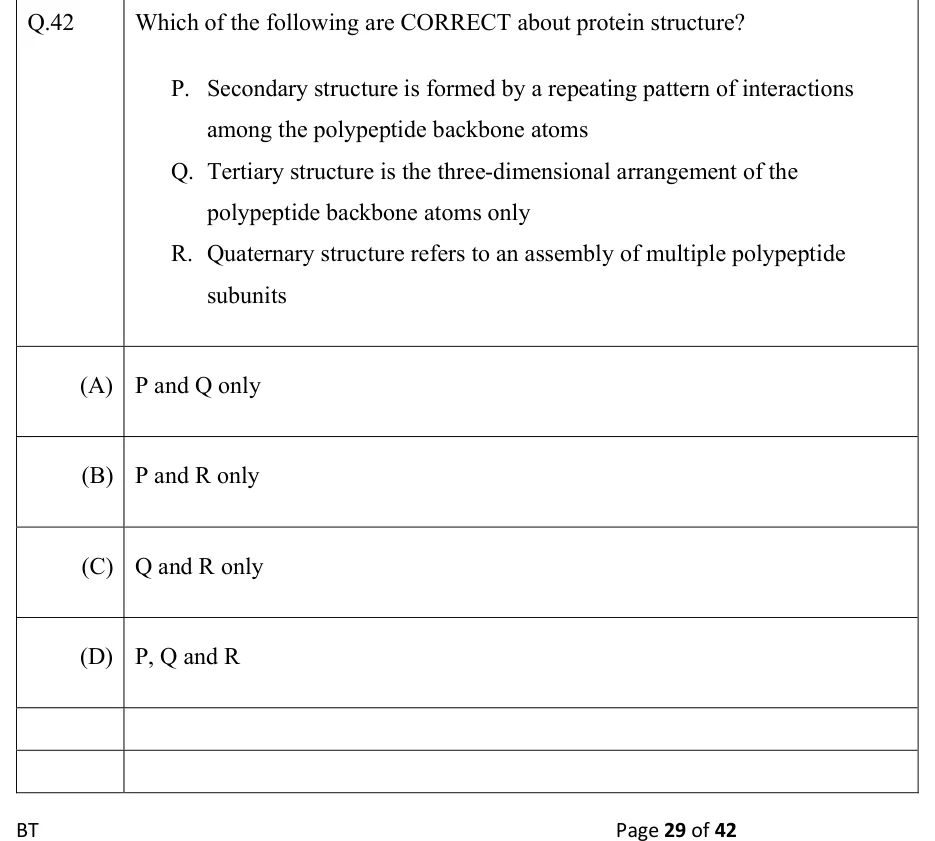
Which of the following are CORRECT about protein structure?
P. Secondary structure is formed by a repeating pattern of interactions among the polypeptide backbone atoms
Q. Tertiary structure is the three-dimensional arrangement of the polypeptide backbone atoms only
R. Quaternary structure refers to an assembly of multiple polypeptide subunits

  1. (A)

    P and Q only

  2. (B)

    P and R only

  3. (C)

    Q and R only

  4. (D)

    P, Q and R

See the question in the paper

Answer and solution

ANSWER

The correct statements are P and R only, which is option (B).

Official answer: BSource: Official answer key, GATE 2022 BT (IIT Kharagpur)

  1. Statement P: secondary structure (-helices and -sheets) is a regular, repeating pattern of hydrogen bonds between the backbone N-H and C=O groups. So P is correct.

  2. Statement Q: tertiary structure is the full three-dimensional fold of one polypeptide chain. It includes the side chains (R groups), which are held by hydrophobic packing, disulfide bonds, ionic bonds, hydrogen bonds and van der Waals forces. Calling it the arrangement of the backbone atoms only is wrong, so Q is incorrect.

  3. Statement R: quaternary structure is the assembly of two or more polypeptide subunits into one protein, for example haemoglobin (). So R is correct.

  4. P and R are correct and Q is not. This rules out (A), (C) and (D), so the answer is (B).

KEY IDEA

Secondary structure comes from backbone hydrogen bonding. Tertiary structure is the whole fold of one chain, side chains included. Quaternary structure is the assembly of several chains.

WATCH OUT FOR

Reading tertiary structure as a backbone-only arrangement and accepting Q because of the phrase "three-dimensional arrangement". The words "backbone atoms only" make it false, since side-chain interactions define the tertiary fold.

From the GATE 2022 BT paper. Every question of this paper · Download the full paper · All 12 Biomolecules questions, with notes

More Biomolecules questions