
IAE Academy

GATE 2024 IN GA Q.9: solution and answer

GATE 2024 · INGA Q.9 · 2 marks · MCQ

Five cubes of identical size and another smaller cube are assembled as shown in Figure A. If viewed from direction X, the planar image of the assembly appears as Figure B.

[Figure A] [Figure B]

If viewed from direction Y, the planar image of the assembly (Figure A) will appear as
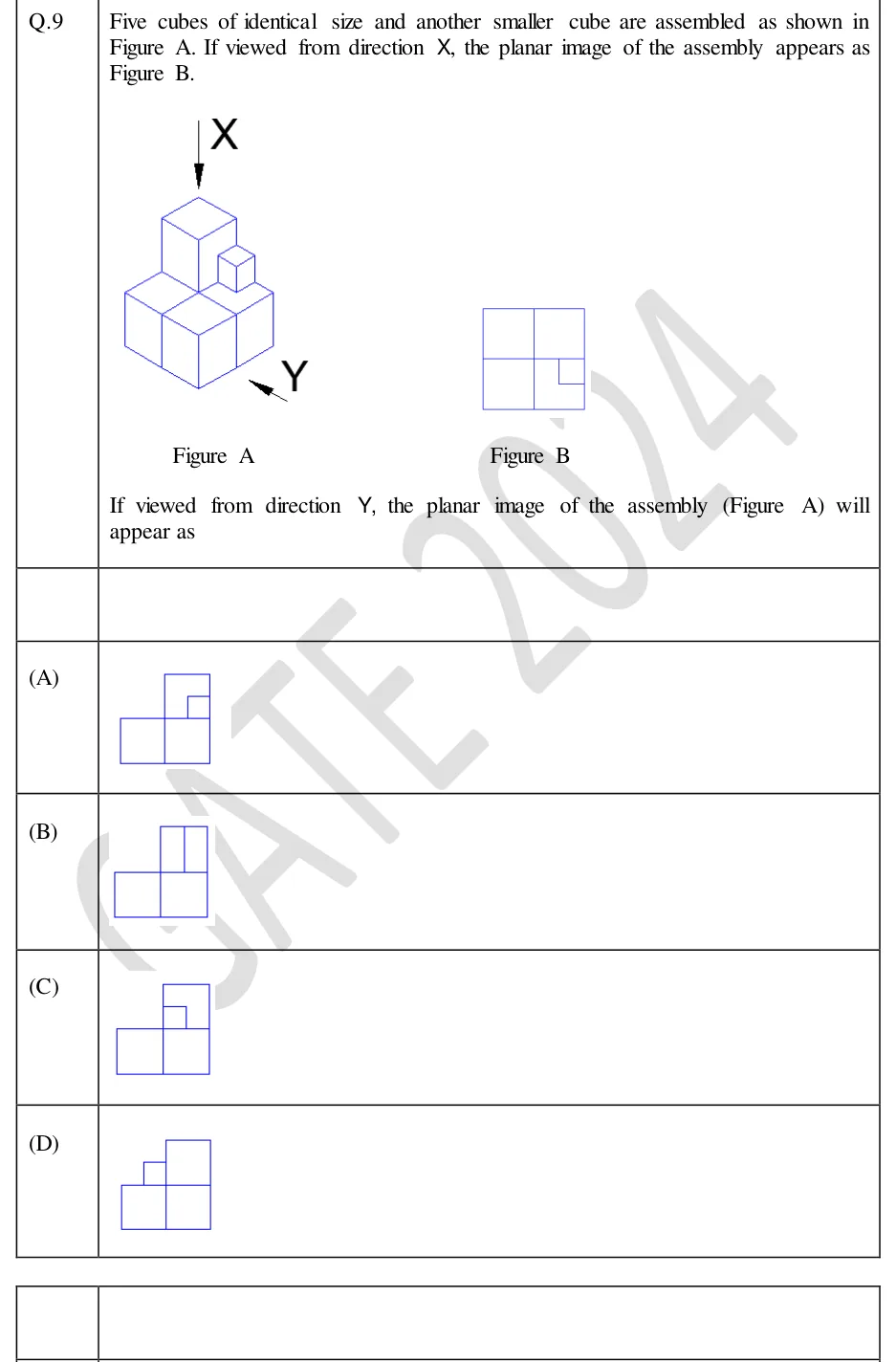
GATE 2024 IN GA question 9: Figure A (isometric line drawing): four identical cubes form a 2 x 2 bottom layer.Tap to open full size
Figure from the GATE 2024 IN paper. It is part of the question.
Figure description

Figure A (isometric line drawing): four identical cubes form a 2 x 2 bottom layer. A fifth identical cube stands on the rear (farthest, top-of-picture) cube of that layer. The smaller cube, with edge half that of the others, rests on top of the right-hand bottom cube, in the corner of its top face that touches the right side face of the upper cube and the outer back-right edge of the block (so its side faces are flush with the upper cube and with the block's back-right face). Arrow X points straight down onto the top of the upper cube (top view). Arrow Y, at the lower right, points up and to the left, perpendicular to the lower-right vertical face of the block (the face formed by the front and right bottom cubes). Figure B (view from X): a square divided into 2 x 2 equal squares; the bottom-right square contains a small square (half its edge) in its upper-right corner.

  1. (A)

    Figure — two equal squares side by side on the bottom and one equal square above the right-hand one (an L-shape); inside the upper square, a small square of half the edge sits in its lower-right corner.

  2. (B)

    Figure — the same L-shape (two squares on the bottom, one above the right-hand one); the upper square is split into two equal halves by a full-height vertical line.

  3. (C)

    Figure — the same L-shape; inside the upper square, a small square of half the edge sits in its lower-left corner.

  4. (D)

    Figure — two equal squares on the bottom and one equal square above the right-hand one; a small square of half the edge sits on top of the left bottom square, outside the upper square and touching its left side.

Answer and solution

ANSWER

The answer is (A): an L-shape with the tall column on the right, and a small square in the lower-right corner of the upper square.

Official answer: ASource: Official answer key, GATE 2024 IN (IISc Bengaluru)

  1. Read the solid from Figure A. The bottom layer is a block of unit cubes: front, left, right and rear. The fifth unit cube stands on the rear cube. The small cube has edge and rests on the right-hand bottom cube, in the corner of its top face that touches the upper cube and the outer (back-right) edge of the block. Figure B, the top view, agrees: the small square sits in the corner of the cell next to the upper cube's cell, touching the edge the two cells share and the outer edge.

  2. Work out what view Y shows. Arrow Y is perpendicular to the lower-right vertical face of the block (the face made by the front and right cubes). So view Y is a straight-on elevation of that face: width runs along the face (two cubes wide) and height is height. The viewer stands on the same side as in Figure A, so left and right stay as drawn. The front corner is on the left and the back-right corner is on the right.

  3. Draw the outline. Each column of the view shows the tallest part along that line of sight. Left column (the front cube, with the left cube behind it): height , so one square at bottom left. Right column (the right cube, with the rear cube and the upper cube behind it): height , so a square on top of a square at the right. This gives the L-shape that every option shares.

  4. Place the small cube vertically. It rests on top of a bottom cube, so its base is on the line between the two rows. Its edge is , so it fills only the lower half of the upper row. It is in front of the upper cube (nearer the viewer), so its outline shows inside the upper square.

  5. Place the small cube sideways. Its outer face lies in the block's back-right face, and in view Y that face is the right-hand edge of the right column. It is wide, so it covers the right half of that column. The small square therefore sits in the lower-right corner of the upper square.

  6. Eliminate the other options. (B) has a half-width strip that runs the full height of the upper square. That would need something a whole cube tall in front of the upper cube, but the small cube is only half as tall. (C) is the mirror image, with the small cube on the inner side. (D) puts the small cube above the left column, outside the upper square. That is impossible, because the small cube lies in the same width band as the tall column. Only (A) matches.

KEY IDEA

An orthographic view flattens the solid along the line of sight. Each column of the image is as tall as the tallest part behind it, and a nearer object's outline appears inside the outline of a farther object it overlaps. Fix left and right from where the viewer stands. Facing the lower-right face, the front corner is on your left and the outer back-right edge is on your right.

WATCH OUT FOR

Getting left and right the wrong way round, as if the face were seen from behind, gives the mirror image (C). Confusing view Y with the view of the other vertical face puts the small cube outside the tall column (D). Forgetting that the small cube is only half as tall draws it as a full-height strip (B).

From the GATE 2024 IN paper. Every question of this paper · Download the full paper · All 23 Spatial questions, with notes

More Spatial questions