
Which one of the options best describes the transformation of the 2-dimensional figure P to Q, and then to R, as shown?
 Tap to open full size
Figure description
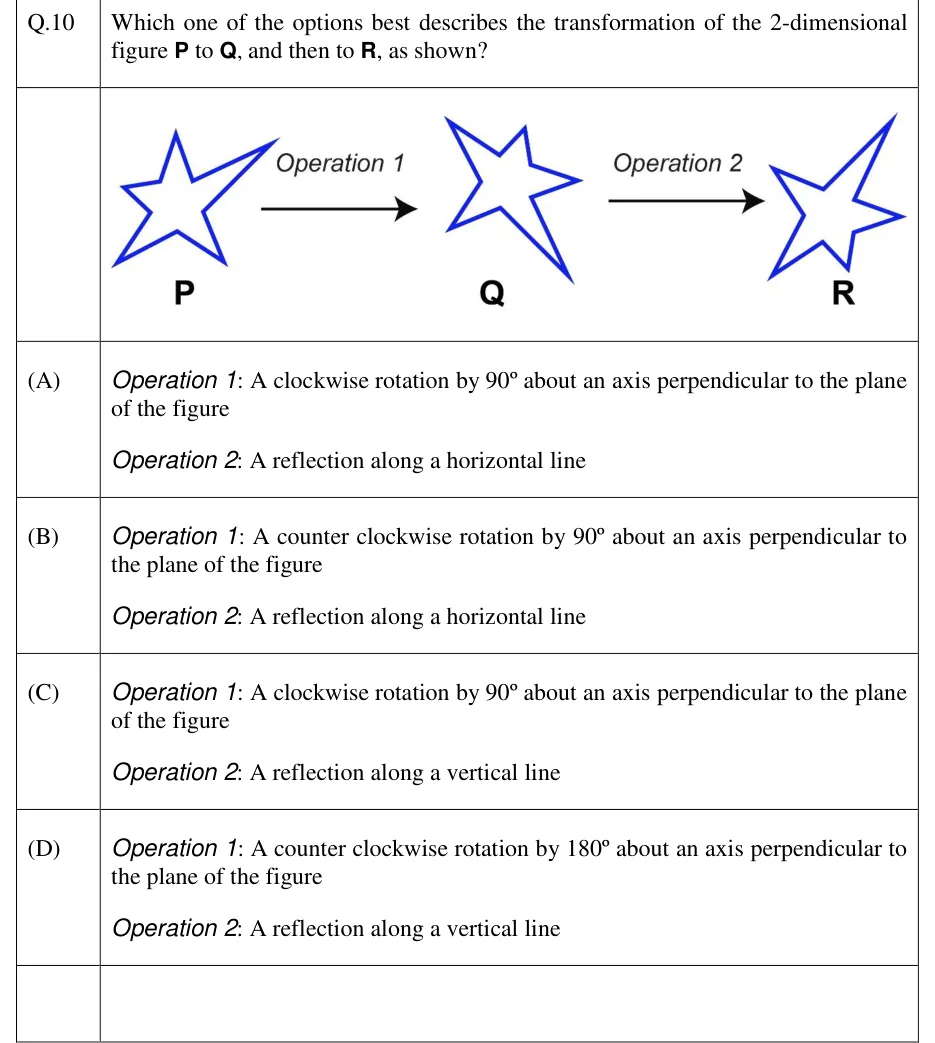
Three blue-outlined, white-filled irregular five-pointed stars in a row, labelled P, Q and R beneath. A black arrow labelled 'Operation 1' points from P to Q, and a black arrow labelled 'Operation 2' points from Q to R. P has one long spike pointing to the upper right (east-north-east), with shorter spikes pointing up, left, lower-left and lower-right. Q is P turned so that its long spike points to the lower right (south-south-east). R is Q flipped top-to-bottom, so its long spike points to the upper right (north-east), with the shorter spikes arranged as a mirror image of Q about a horizontal line.
- (A)
Operation 1: A clockwise rotation by 90º about an axis perpendicular to the plane of the figure. Operation 2: A reflection along a horizontal line
- (B)
Operation 1: A counter clockwise rotation by 90º about an axis perpendicular to the plane of the figure. Operation 2: A reflection along a horizontal line
- (C)
Operation 1: A clockwise rotation by 90º about an axis perpendicular to the plane of the figure. Operation 2: A reflection along a vertical line
- (D)
Operation 1: A counter clockwise rotation by 180º about an axis perpendicular to the plane of the figure. Operation 2: A reflection along a vertical line