
IAE Academy

GATE 2023 EC GA Q.5: solution and answer

GATE 2023 · ECGA Q.5 · 1 mark · MCQ

How many rectangles are present in the given figure?
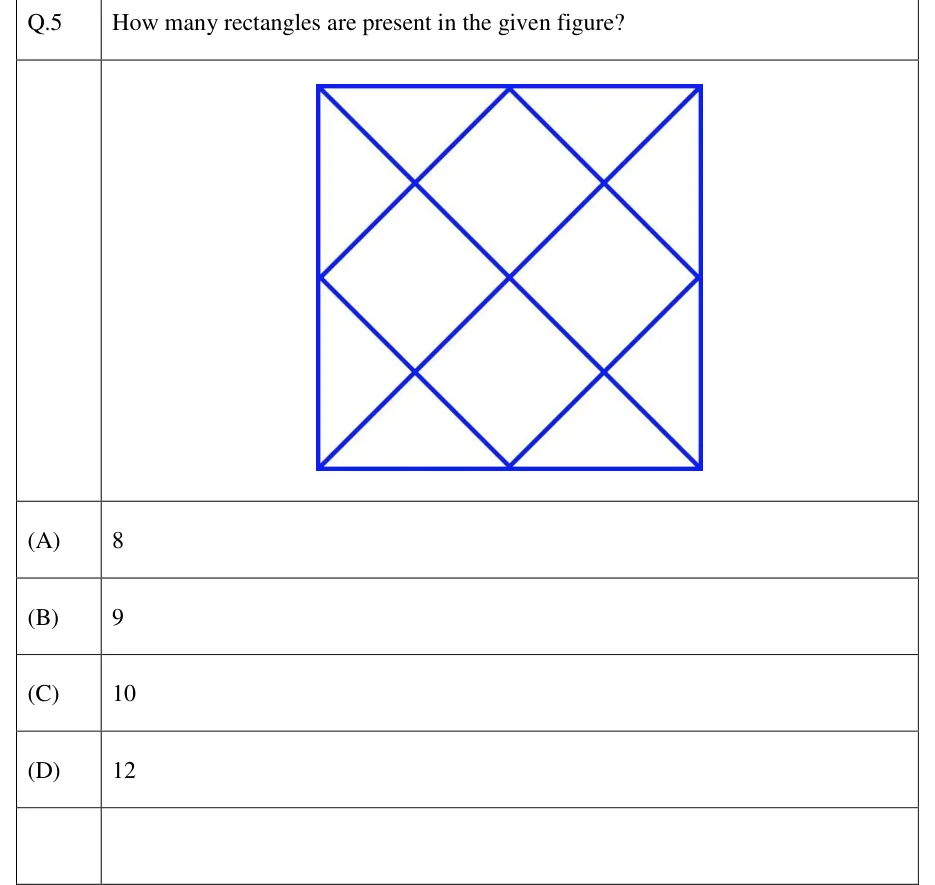
GATE 2023 EC GA question 5: A square outline (drawn in blue lines, no shading).Tap to open full size
Figure from the GATE 2023 EC paper. It is part of the question.
Figure description

A square outline (drawn in blue lines, no shading). Take the corners as A (top-left), B (top-right), C (bottom-right), D (bottom-left), and the midpoints of the sides as P (top side), Q (right side), R (bottom side), S (left side). Both diagonals are drawn: AC from the top-left corner to the bottom-right corner, and BD from the top-right corner to the bottom-left corner, crossing at the centre O. The four midpoints are joined in order to form a tilted square (a diamond): PS, SR, RQ and QP. Each diagonal crosses two sides of the diamond at their midpoints. Together the diagonals and the diamond split the diamond into 4 equal small tilted squares that meet at O, and leave 4 corner triangles outside the diamond (at A, B, C, D), each of which is cut in two by the diagonal. There are no other lines and no labels in the figure.

  1. (A)

    8

  2. (B)

    9

  3. (C)

    10

  4. (D)

    12

Answer and solution

ANSWER

The figure has 10 rectangles: the outer square plus 9 tilted rectangles inside the diamond (4 small squares, 4 two-square rectangles and the diamond itself). The answer is (C) 10.

Official answer: CSource: Official answer key, GATE 2023 EC (IIT Kanpur)

  1. Sort the lines by direction. Horizontal and vertical: only the four sides of the outer square. Slanting one way (): the diagonal and the diamond sides and . Slanting the other way (): the diagonal and the diamond sides and .

  2. A rectangle needs every corner to be a right angle. The horizontal and vertical lines meet each other at but meet the slanting lines at , so a rectangle cannot mix the two kinds of line. The only rectangle made from horizontal and vertical lines is the outer square : 1.

  3. The six slanting lines form a tilted grid: 3 parallel lines one way (, , ) and 3 parallel lines the other way (, , ), and the two families are perpendicular. Each line of one family crosses every line of the other family at a point that is actually drawn (the 9 crossings are , , , , the centre and the four midpoints of the diamond's sides). So the diamond is a grid of small squares.

  4. Rule: a grid formed by parallel lines crossing perpendicular parallel lines, with every crossing drawn, contains rectangles, one for each choice of two lines from each family.

  5. Tilted rectangles: . These are the 4 small squares, the 4 rectangles made of two small squares side by side (2 in each direction), and the diamond itself: .

  6. Outside the diamond, the diagonals only cut the four corner triangles in two and have no parallel partner there, so they form no further rectangle.

  7. Total , which is option (C).

KEY IDEA

A rectangle's sides come from two pairs of perpendicular parallel lines. Sort the lines into perpendicular families. A grid of lines crossing lines contains rectangles. Here that is for the tilted grid, plus the outer square: 10.

WATCH OUT FOR

Counting only the 4 small squares, or forgetting that a square is also a rectangle, so the 2x1 rectangles, the diamond or the outer square get left out. Answers of 8 or 9 usually come from missing the outer square or the diamond. Another mistake is counting the corner triangles or treating a diagonal as the side of an extra rectangle outside the diamond.

From the GATE 2023 EC paper. Every question of this paper · Download the full paper · All 23 Spatial questions, with notes

More Spatial questions