
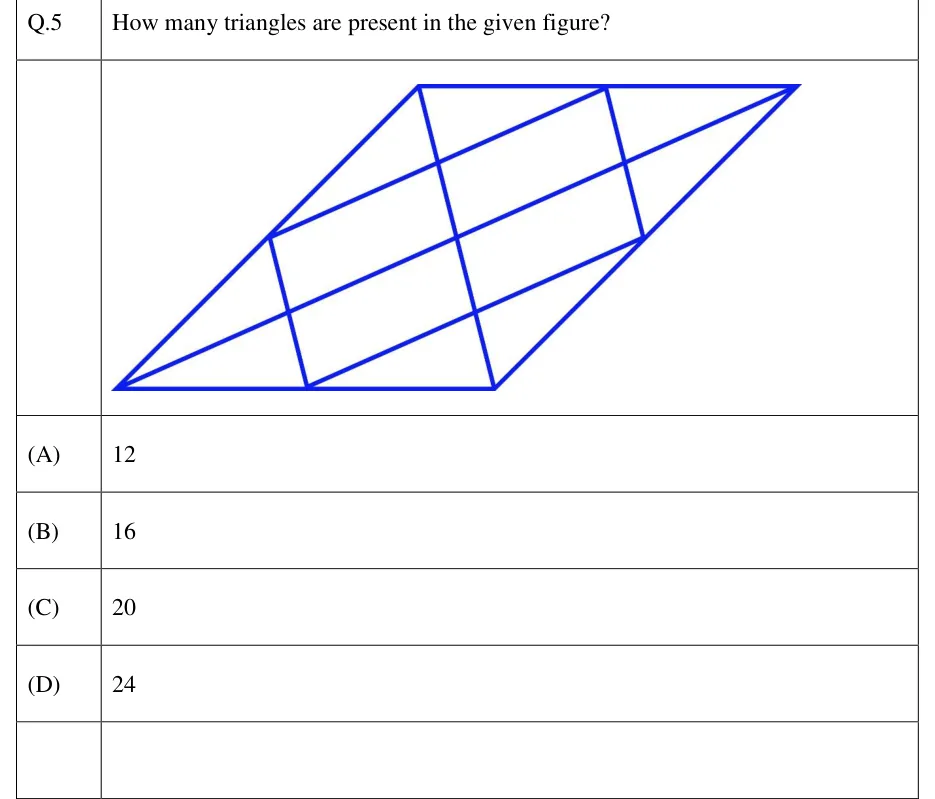
How many triangles are present in the given figure?
 Tap to open full size
Figure description
A parallelogram drawn in blue lines. Its top and bottom sides are horizontal, and the top side is shifted to the right of the bottom side, so the left and right sides slope up to the right. Label the corners A (bottom-left), B (bottom-right), C (top-right) and D (top-left). Both diagonals are drawn: the long one from A (bottom-left) to C (top-right), and the short, steep one from D (top-left) to B (bottom-right). The two diagonals cross at the centre O. The midpoints of the four sides, Q on AB, R on BC, P on CD and L on DA, are joined in order L-P, P-R, R-Q, Q-L. This makes an inner parallelogram that looks almost like a tilted rectangle. Its sides L-P and Q-R are parallel to diagonal AC, and its sides L-Q and P-R are parallel to diagonal DB. Diagonal AC crosses L-Q at E and P-R at F. Diagonal DB crosses L-P at H and Q-R at G. There are no other lines and no labels in the printed figure.
- (A)
12
- (B)
16
- (C)
20
- (D)
24