
IAE Academy

GATE 2023 BT GA Q.5: solution and answer

GATE 2023 · BTGA Q.5 · 1 mark · MCQ

A line of symmetry is defined as a line that divides a figure into two parts in a way such that each part is a mirror image of the other part about that line.

The given figure consists of 16 unit squares arranged as shown. In addition to the three black squares, what is the minimum number of squares that must be coloured black, such that both PQ and MN form lines of symmetry? (The figure is representative)
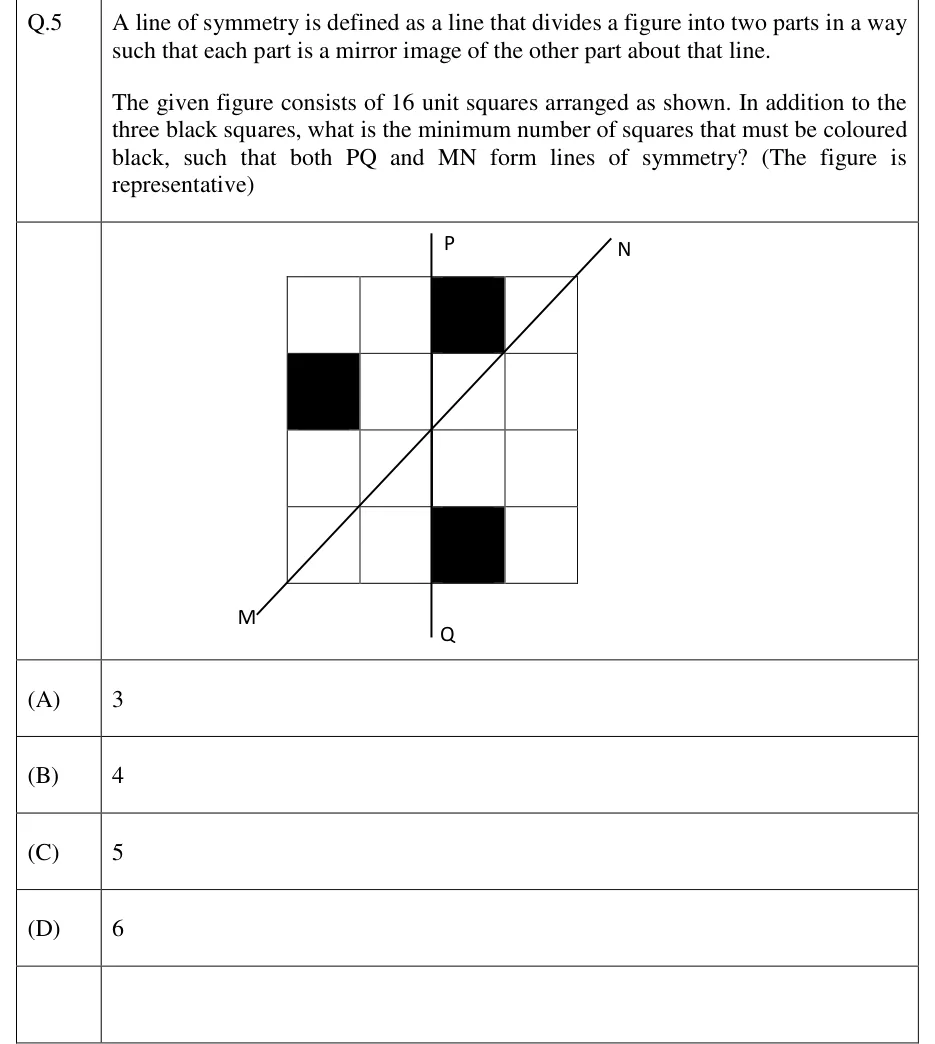
GATE 2023 BT GA question 5: A 4 x 4 grid of unit squares.Tap to open full size
Figure from the GATE 2023 BT paper. It is part of the question.
Figure description

A 4 x 4 grid of unit squares. Number rows 1 to 4 from the top and columns 1 to 4 from the left. Three squares are black: row 1 column 3, row 2 column 1, and row 4 column 3. All others are white. A vertical line PQ (P at top, Q at bottom) runs through the middle of the grid, between columns 2 and 3, extending slightly beyond the grid at both ends. A slanted line MN runs at 45 degrees from M at the bottom-left corner of the grid to N at the top-right corner, so it is the diagonal of the grid and crosses PQ at the centre of the grid.

  1. (A)

    3

  2. (B)

    4

  3. (C)

    5

  4. (D)

    6

Answer and solution

ANSWER

The minimum number of extra squares to colour black is 5, which is option (C).

Official answer: CSource: Official answer key, GATE 2023 BT (IIT Kanpur)

  1. Label each cell as (row, column), with rows counted from the top and columns from the left, in the 4 x 4 grid. The black cells are (1,3), (2,1) and (4,3). PQ is the vertical line between columns 2 and 3. MN is the diagonal from the bottom-left corner to the top-right corner. The two lines meet at the centre of the grid.

  2. Reflecting in PQ sends column to column , so . Reflecting in MN sends . This fixes the bottom-left corner (4,1) and the top-right corner (1,4), which both lie on MN.

  3. The figure must look the same after both reflections. So whenever a cell is black, every cell reached from it by any chain of these two reflections must also be black. The two mirror lines meet at , so their reflections together give the 8 symmetries of a square.

  4. Follow the chain from the black cell (1,3). Reflect in PQ to get (1,2). Reflect in MN to get (3,4). Reflect in PQ to get (3,1). Reflect in MN to get (4,2)... Carrying on from the other cells gives the full set: (1,2), (1,3), (2,1), (2,4), (3,1), (3,4), (4,2), (4,3). That is 8 cells.

  5. Check that the three given black cells are all in this set: (1,3) is in it. Under MN, (1,3) goes to (2,4), and under PQ, (2,4) goes to (2,1). Under MN, (2,1) goes to (4,3). So (2,1) and (4,3) are in the same set.

  6. All 8 cells of this set must be black, and only these. The other 8 cells form sets of their own: (1,1), (1,4), (4,1), (4,4) and (2,2), (2,3), (3,2), (3,3). They are already white and form a symmetric pattern, so no more cells are needed.

  7. Cells still to be coloured: . The minimum number of extra squares is 5, which is option (C).

KEY IDEA

A figure with two lines of symmetry must be a union of whole sets of cells that the reflections swap among themselves. Find the set containing each black cell, colour the whole set, and count the cells that were not already black.

WATCH OUT FOR

Colouring only the mirror images of each black cell in one line, or in a single step, and stopping. The mirror images of the new cells in the other line must be coloured too, and so on until the set closes. This gives 3 or 4 instead of 5.

From the GATE 2023 BT paper. Every question of this paper · Download the full paper · All 48 Spatial questions, with notes

More Spatial questions