
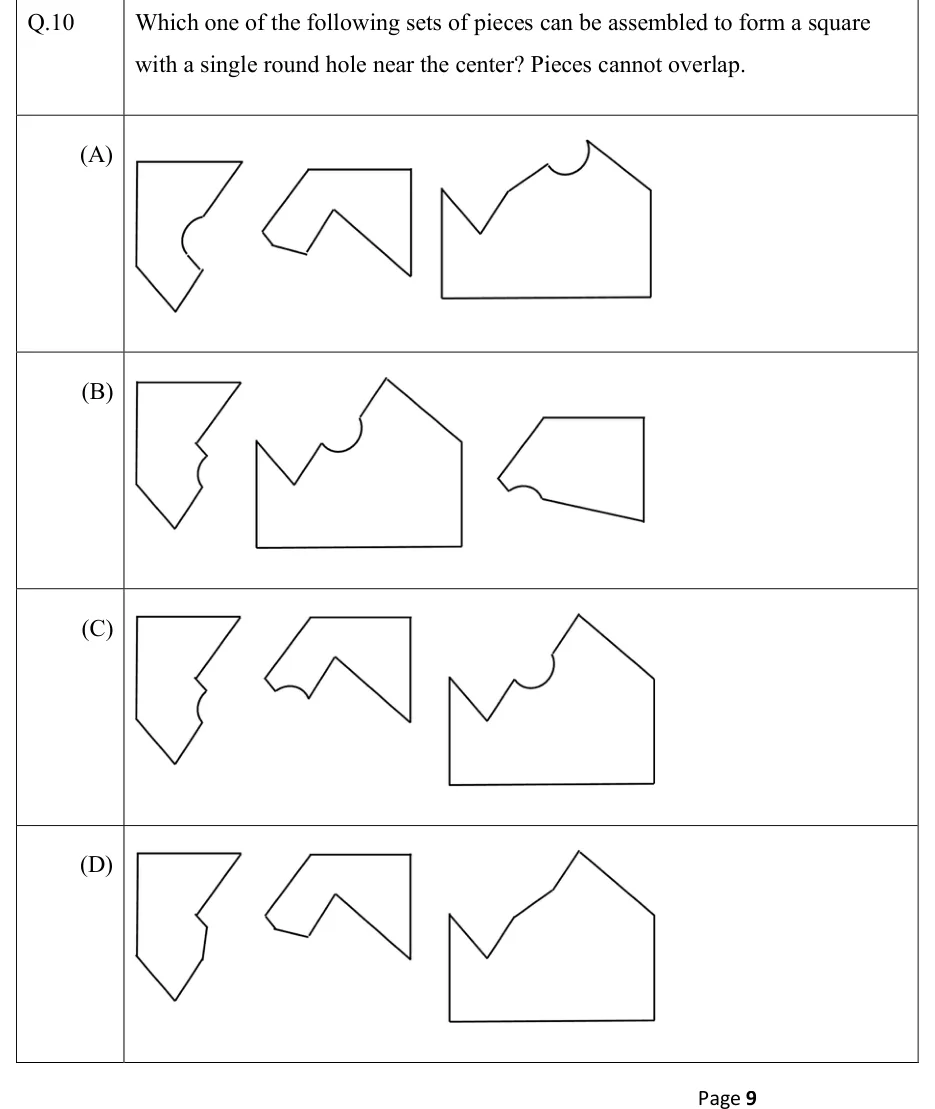
Which one of the following sets of pieces can be assembled to form a square with a single round hole near the center? Pieces cannot overlap.
 Tap to open full size
Figure description
Four options. Each is a row of three flat outline drawings with no shading. Three basic pieces recur. (P) Left piece: a horizontal top edge and a vertical left edge meet at a right angle at the top-left. From the right end of the top edge, a long edge slants down-left to a small vertex. From there a short edge (the kink) steps down-right, followed by a short, nearly vertical lower-right edge. At the bottom, one slant runs down-right from the foot of the left edge and another runs down-left from the foot of the lower-right edge; they meet in a downward point. (Q) Chevron piece: a horizontal top edge and a vertical right edge meet at a right angle at the top-right. From the bottom of the right edge, a long edge slants up-left to an inner (concave) corner, then an edge runs down-left to a lower tip. From the tip a short edge runs left (slightly upward) to a small corner, a short edge slants up-left, and a long edge slants up-right back to the left end of the top edge. (R) Large piece: a horizontal bottom edge and vertical left and right edges of about equal height, with right angles at both bottom corners. Its top profile, left to right: from the top of the left edge down-right to the bottom of a V-shaped notch; up-right to a vertex; a gentler edge up-right to a bend; a steeper edge up-right to the peak (the highest point, right of centre); then down-right to the top of the right edge. Order: in options A, C and D the pieces appear left to right as P, Q, R. In option B the order is P, R, then the modified Q. Variations: (A) P has no kink. Its long slant runs straight into a large semicircular notch cut into its right side. Below the notch a short edge steps down-right, and the lower-right slant then runs down-left to the bottom point. Q has only straight edges. In R the gentler edge after the V is straight, and a semicircular notch replaces the steeper edge, with the notch's right end at the peak. (B) P has the kink plus a small circular-arc notch in its lower-right edge. R (middle) has a large, nearly semicircular notch in place of the gentler edge; the steeper edge up to the peak is straight. The right-hand piece is Q without its V-cut: a horizontal top, a vertical right side, and a straight bottom edge from the bottom-right corner up-left to a small circular-arc notch, then the short up-left slant and the long up-right slant back to the top-left. It is a four-sided shape with one arc. (C) P has the kink plus a small circular-arc notch in its lower-right edge. Q has a small circular-arc notch in place of its short edge next to the lower tip. R has a large, nearly semicircular notch in place of the gentler edge; the steeper edge up to the peak is straight. (D) All edges are straight and there are no notches: P has the kink and a straight lower-right edge, Q has a straight short edge by the tip, and R has both the gentler and the steeper edge straight.
- (A)
Figure — P with no kink and a large semicircular notch on its right side, with a short step below the notch; Q with all straight edges; R with a semicircular notch on the steep edge that ends at its peak
- (B)
Figure — P with kink and a small arc notch; R (middle) with a large near-semicircular notch between its V and its steep edge; right-hand piece a four-sided shape (Q without its V-cut) with a small arc notch at its lower left
- (C)
Figure — P with kink and a small arc notch on its lower-right edge; Q with a small arc notch on its short edge next to the tip; R with a large near-semicircular notch between its V and its steep edge
- (D)
Figure — P, Q and R with all edges straight, no notches