
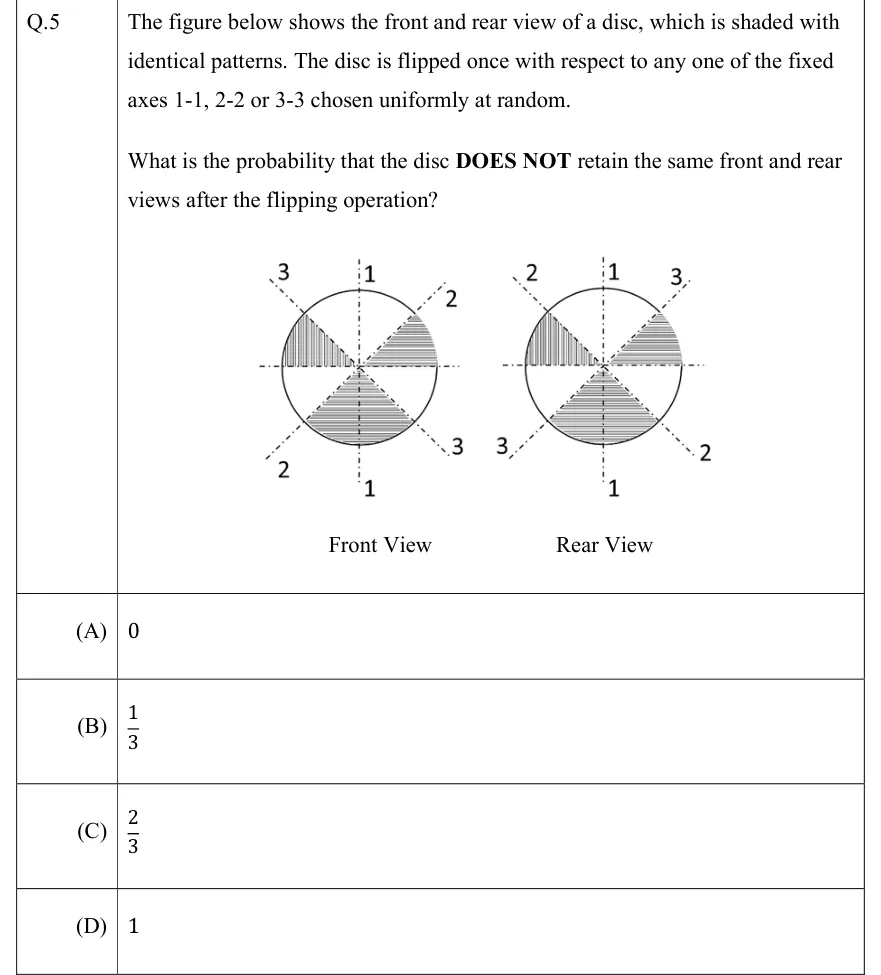
The figure below shows the front and rear view of a disc, which is shaded with identical patterns. The disc is flipped once with respect to any one of the fixed axes 1-1, 2-2 or 3-3 chosen uniformly at random.
What is the probability that the disc DOES NOT retain the same front and rear views after the flipping operation?
 Tap to open full size
Figure description
Two equal circles side by side, captioned "Front View" (left) and "Rear View" (right). In each circle a vertical dash-dot diameter runs past the rim and is labelled 1 at the top and 1 at the bottom (axis 1-1). Each circle also has an unlabelled horizontal dash-dot diameter and two slanted dash-dot diameters through the centre. The slanted diameters run past the rim, each at about 45 degrees to the horizontal, so they are roughly perpendicular to each other. Front View: axis 3-3 runs from upper-left (label 3) to lower-right (label 3), and axis 2-2 from upper-right (label 2) to lower-left (label 2). Rear View: the slanted labels are mirrored, with 2 at upper-left and lower-right and 3 at upper-right and lower-left. Axis 1-1 is unchanged. Both views are shaded identically: (i) the upper-left sector, between the left horizontal radius and the upper-left slanted radius (about 45 degrees), has vertical hatching; (ii) the upper-right sector, between the right horizontal radius and the upper-right slanted radius (about 45 degrees), has horizontal hatching; (iii) the large bottom sector, between the lower-left and lower-right slanted radii (about 90 degrees) and bisected by the lower half of 1-1, has horizontal hatching. Three regions are left white: the top region between the two upper slanted radii (about 90 degrees, containing the top of 1-1), and the two lower side regions between each horizontal radius and the adjacent lower slanted radius (about 45 degrees each).
- (A)
0
- (B)
- (C)
- (D)
1