
IAE Academy

GATE 2025 EE GA Q.7: solution and answer

GATE 2025 · EEGA Q.7 · 2 marks · MCQ

In the given figure, EF and HJ are coded as 30 and 80, respectively. Which one among the given options is most appropriate for the entries marked (i) and (ii) ?
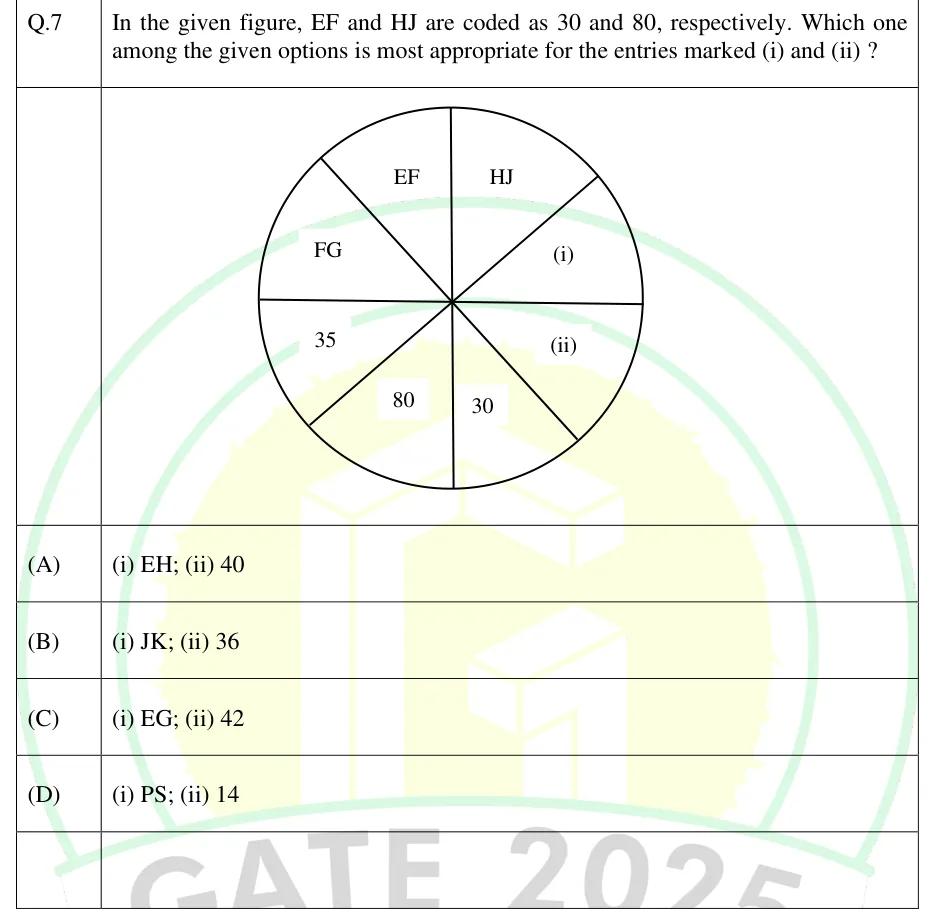
GATE 2025 EE GA question 7: A circle divided into 8 equal sectors by four lines through the centre: one vertical, one horizontal, and two diagonals…Tap to open full size
Figure from the GATE 2025 EE paper. It is part of the question.
Figure description

A circle divided into 8 equal sectors by four lines through the centre: one vertical, one horizontal, and two diagonals (upper-left to lower-right, and upper-right to lower-left). Going clockwise from the top, the entries in the sectors are: HJ (between the top of the vertical line and the upper-right diagonal), (i) (between the upper-right diagonal and the right half of the horizontal line), (ii) (between the right half of the horizontal line and the lower-right diagonal), 30 (between the lower-right diagonal and the bottom of the vertical line), 80 (between the bottom of the vertical line and the lower-left diagonal), 35 (between the lower-left diagonal and the left half of the horizontal line), FG (between the left half of the horizontal line and the upper-left diagonal), and EF (between the upper-left diagonal and the top of the vertical line). So diametrically opposite pairs are EF and 30, HJ and 80, (i) and 35, (ii) and FG.

  1. (A)

    (i) EH; (ii) 40

  2. (B)

    (i) JK; (ii) 36

  3. (C)

    (i) EG; (ii) 42

  4. (D)

    (i) PS; (ii) 14

Answer and solution

ANSWER

(C) (i) EG; (ii) 42. A letter pair is coded as the product of its letters' alphabet positions, and each code sits in the sector diametrically opposite its pair. So (i), opposite 35, is EG (), and (ii), opposite FG, is .

Official answer: CSource: Official answer key, GATE 2025 EE (IIT Roorkee)

  1. Write the alphabet positions of the letters: , , , , .

  2. Find the rule from the two given codes. Multiply the positions: and . Both match, so a letter pair is coded as the product of its letters' positions.

  3. Find where the pairs sit in the figure. EF and its code 30 are in diametrically opposite sectors, and so are HJ and 80. So each code sits in the sector opposite its letter pair.

  4. (i) is opposite 35, so (i) must be a letter pair whose positions multiply to 35. Since , the pair is and , so (i) is EG.

  5. (ii) is opposite FG, so (ii) is the code of FG: .

  6. Check the other options. (A): EH gives , not 35, and 40 is not 42. (B): JK gives , and 36 is not 42. (D): PS gives , and 14 is not 42. Only option (C), (i) EG and (ii) 42, fits both entries.

KEY IDEA

Get the rule from both examples: EF = 30 and HJ = 80 are the products of alphabet positions ( and ). Then get the layout from the figure: each code sits in the sector diametrically opposite its letter pair. The layout says which pair (i) and (ii) belong to, and the rule gives their values.

WATCH OUT FOR

Assuming that (i) and (ii), which sit next to each other, are a letter pair and its code. On that reading option (A) looks right, because EH gives , matching its (ii) = 40. The figure rules this out: EF is not next to 30, and HJ is not next to 80. Each code is diametrically opposite its pair, so (ii) must be FG's code, 42. Other slips are adding the positions instead of multiplying them (, not 30) and miscounting J as 9.

From the GATE 2025 EE paper. Every question of this paper · Download the full paper · All 41 Reasoning questions, with notes

More Reasoning questions