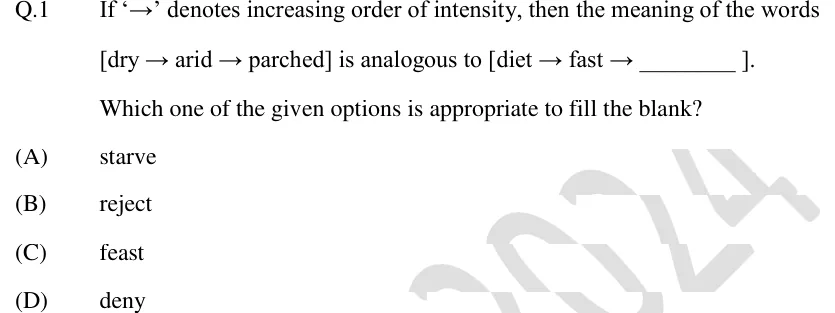
If ‘→’ denotes increasing order of intensity, then the meaning of the words [dry → arid → parched] is analogous to [diet → fast → ________ ].
Which one of the given options is appropriate to fill the blank?
- (A)
starve
- (B)
reject
- (C)
feast
- (D)
deny

If ‘→’ denotes increasing order of intensity, then the meaning of the words [dry → arid → parched] is analogous to [diet → fast → ________ ].
Which one of the given options is appropriate to fill the blank?
starve
reject
feast
deny
ANSWER
The blank is filled by 'starve', option (A).
Official answer: ASource: Official answer key, GATE 2024 CS1 (IISc Bengaluru)
The arrow means increasing intensity: each word in the chain is a stronger form of the same idea as the word before it.
Check the given chain: dry, then arid (very dry), then parched (extremely dry). The idea stays the same (lack of moisture) and its degree rises.
Now read [diet → fast]. Both are about limiting food intake. A diet is mild restriction, and a fast is a stronger, deliberate abstention from food.
The blank must be the next stronger degree of the same idea, which is going without food to the point of suffering.
Test the options. 'starve' means to suffer or die from lack of food, the extreme end of food deprivation, so it fits.
'reject' and 'deny' are not about food intake. 'feast' is the opposite idea, since it means eating lavishly, so it breaks the pattern.
Therefore the blank is 'starve', which is option (A).
KEY IDEA
In an intensity chain, find the shared idea (here, restricting food) and pick the option that is the next, stronger degree of that same idea. Diet, then fast, then starve.
WATCH OUT FOR
Picking 'deny' or 'reject' because they sound like refusing something. They are not about food and are not a stronger degree of fasting. Picking 'feast' ignores that the direction is increasing restriction.
From the GATE 2024 CS1 paper. Every question of this paper · Download the full paper · All 72 Reasoning questions, with notes