IAE Academy

GATE 2026 DA GA Q.8: solution and answer

GATE 2026 · DAGA Q.8 · 2 marks · MCQ

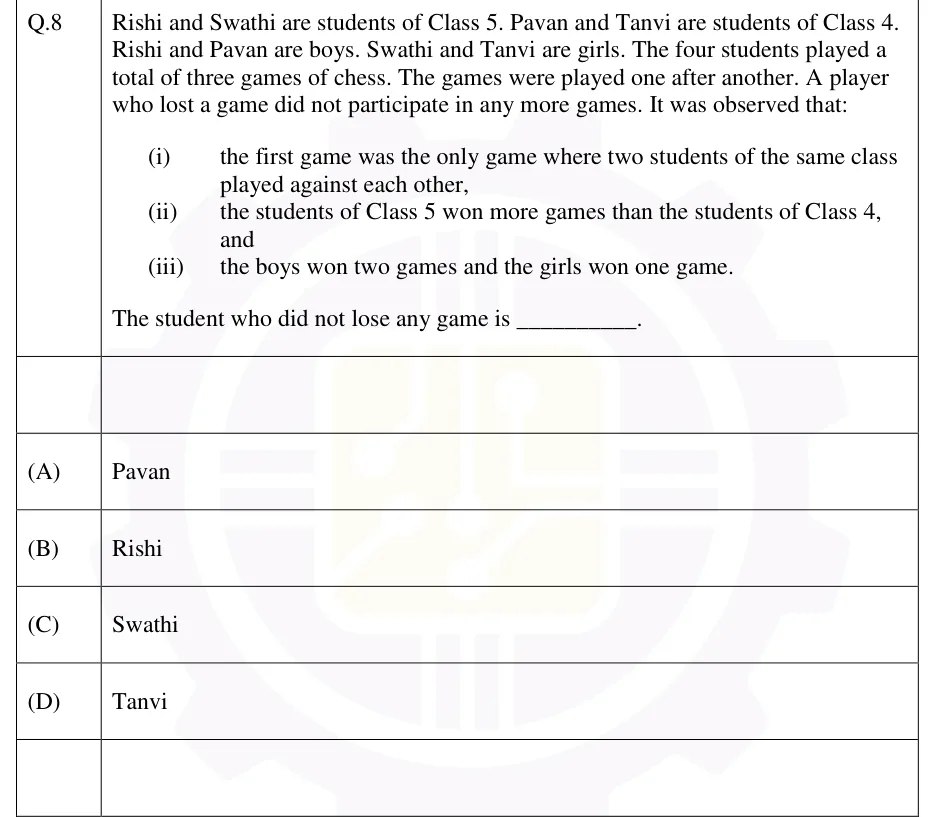
Rishi and Swathi are students of Class 5. Pavan and Tanvi are students of Class 4. Rishi and Pavan are boys. Swathi and Tanvi are girls. The four students played a total of three games of chess. The games were played one after another. A player who lost a game did not participate in any more games. It was observed that:
(i) the first game was the only game where two students of the same class played against each other,
(ii) the students of Class 5 won more games than the students of Class 4, and
(iii) the boys won two games and the girls won one game.
The student who did not lose any game is ______.

  1. (A)

    Pavan

  2. (B)

    Rishi

  3. (C)

    Swathi

  4. (D)

    Tanvi

See the question in the paper

Answer and solution

ANSWER

Tanvi (option D).

Official answer: DSource: Official answer key, GATE 2026 DA (IIT Guwahati)

  1. Every game has exactly one loser, and a loser takes no further part. So the three games remove three different players, and the one student who never loses is the winner of game 3.

  2. By (i), game 1 is the only game between two students of the same class. So game 1 is either Rishi vs Swathi (both Class 5) or Pavan vs Tanvi (both Class 4), and games 2 and 3 must each be between students of different classes.

  3. Suppose game 1 is Pavan vs Tanvi. Its winner is a Class 4 student, and the loser is out. Game 2 must then be that winner against a Class 5 student. If the Class 5 student won, the two players left for game 3 would be Rishi and Swathi, both Class 5, which (i) forbids. So the Class 4 student wins game 2 and has 2 wins. Class 5 can then win at most the 1 remaining game, which contradicts (ii). So this case is impossible.

  4. Hence game 1 is Rishi vs Swathi. Its winner W is a Class 5 student, and the loser is out. Game 2 must be W against a Class 4 student X. If X won, game 3 would be X against the other Class 4 student, which (i) forbids. So W wins game 2 as well.

  5. Game 3 is W against the other Class 4 student Y. If W won, W would have 3 wins, but (iii) allows only 2 wins for the boys and 1 for the girls, so the wins could not be split that way. Hence Y beats W. Class 5 has 2 wins and Class 4 has 1 win, which agrees with (ii).

  6. W has two wins and Y has one. By (iii), the two wins belong to the boys and the one win to the girls. Since both of the boys' wins are W's, W is a boy, so W = Rishi. Then Y, whose single win is the girls' win, is a girl, so Y = Tanvi.

  7. Check: Swathi lost game 1, Pavan lost game 2, Rishi lost game 3, and Tanvi played only game 3 and won it. So the student who did not lose any game is Tanvi.

KEY IDEA

Each game eliminates exactly one player, so the only student who never loses is the winner of the last game. Condition (i) fixes which pairs can meet in games 2 and 3, and (ii) and (iii) then fix the winners.

WATCH OUT FOR

Starting with Pavan vs Tanvi in game 1, or letting a Class 4 student win game 2. Both lead to two students of the same class meeting again in game 3, or to Class 4 outscoring Class 5. Another slip is to forget that the loser of each game is out, which is what makes game 3's pair forced.

From the GATE 2026 DA paper. Every question of this paper · Download the full paper · All 72 Reasoning questions, with notes

More Reasoning questions