
IAE Academy

GATE 2026 EC GA Q.7: solution and answer

GATE 2026 · ECGA Q.7 · 2 marks · MCQ

Three children P, Q, R and two grown-ups X, Y play a badminton doubles tournament. X and Y are parents to two of the children playing. The child of X is not the same as the child of Y. Exactly one of the children does not have a parent playing in the tournament. The following rules are followed:

(i) A parent and his/her child cannot be on the same team.
(ii) A match can feature at most one parent and his/her child, that is, a maximum of one parent-child pair can play in a match.

The following matches were played:

| | TEAM 1 | TEAM 2 |
|---|---|---|
| MATCH 1 | P and X | Q and R |
| MATCH 2 | P and R | X and Y |
| MATCH 3 | R and X | Q and Y |

Which one of the following options is correct?
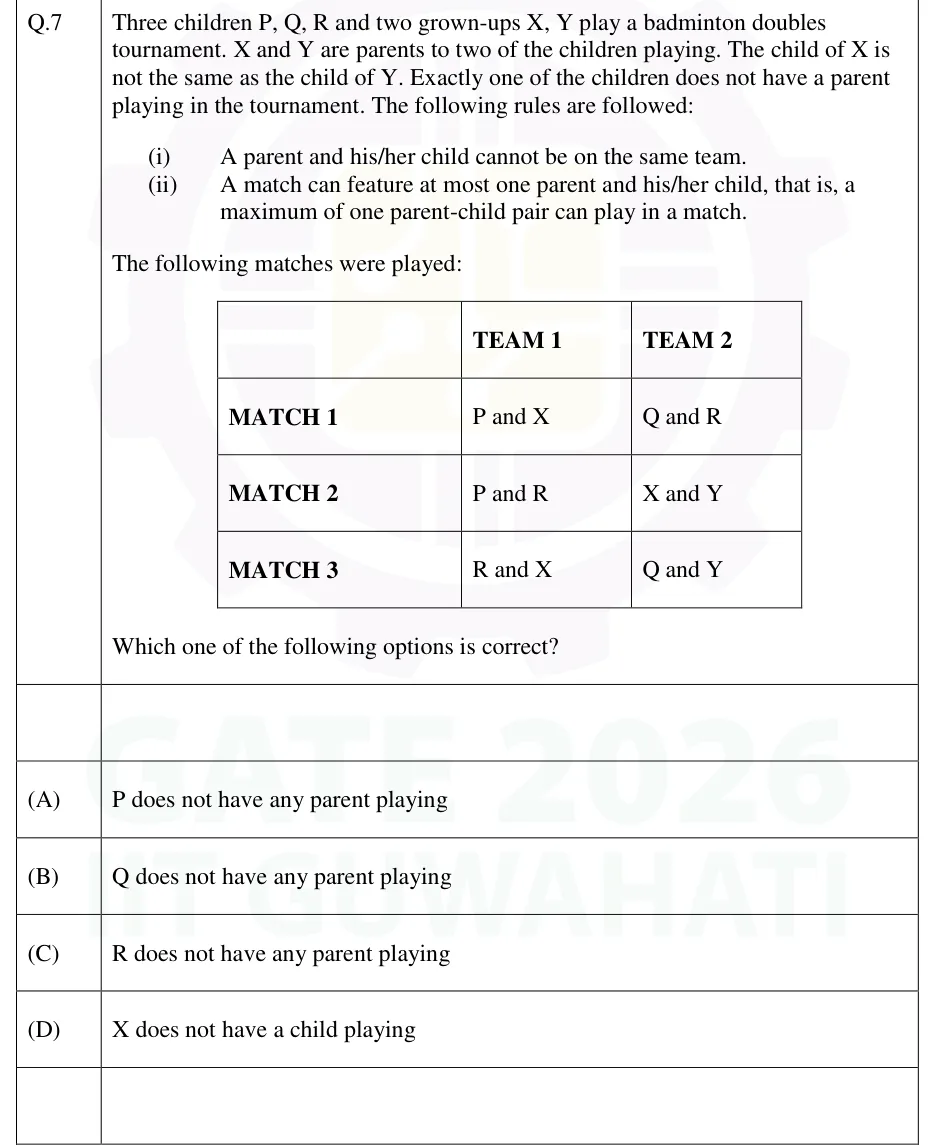
GATE 2026 EC GA question 7: A table with three columns headed (blank), TEAM 1, TEAM 2 and three rows: MATCH 1 — Team 1: P and X, Team 2: Q and R;Tap to open full size
Figure from the GATE 2026 EC paper. It is part of the question.
Figure description

A table with three columns headed (blank), TEAM 1, TEAM 2 and three rows: MATCH 1 — Team 1: P and X, Team 2: Q and R; MATCH 2 — Team 1: P and R, Team 2: X and Y; MATCH 3 — Team 1: R and X, Team 2: Q and Y.

  1. (A)

    P does not have any parent playing

  2. (B)

    Q does not have any parent playing

  3. (C)

    R does not have any parent playing

  4. (D)

    X does not have a child playing

Answer and solution

ANSWER

(C) R does not have any parent playing. X is Q's parent and Y is P's parent.

Official answer: CSource: Official answer key, GATE 2026 EC (IIT Guwahati)

  1. Set-up: X and Y each have one child among P, Q, R, and the two children are different. So exactly one child has no parent playing, and option (D) is false from the start: the question says X is a parent of one of the children playing.

  2. Rule (i): a parent and child are never on the same team. Match 1 puts P with X, so X is not P's parent. Match 3 puts R with X, so X is not R's parent. That leaves only one possibility: X is Q's parent.

  3. Rule (i) again: in Match 3, Q is on Y's team, so Y is not Q's parent. (This also follows from X and Y having different children.) Y's child must therefore be P or R.

  4. Rule (ii): a match can have at most one parent-child pair. In Match 3, X (Team 1) plays against Q (Team 2), so that match already has its one pair. If Y were R's parent, Y (Team 2) playing against R (Team 1) would be a second pair in the same match. So Y is not R's parent, and Y is P's parent.

  5. Check every match with X as Q's parent and Y as P's parent. Match 1 (P and X vs Q and R): Y is not playing, so the only pair is X and Q, on opposite teams. Match 2 (P and R vs X and Y): Q is not playing, so the only pair is Y and P, on opposite teams. Match 3 (R and X vs Q and Y): P is not playing, so the only pair is X and Q, on opposite teams. No parent is ever on the same team as their own child, and no match has more than one pair. Both rules hold.

  6. So X is Q's parent and Y is P's parent, which leaves R as the one child with no parent playing. Option (C) is correct.

KEY IDEA

Use rule (i) first, because it removes candidates directly: anyone who has partnered a grown-up cannot be that grown-up's child. Partnering P and R leaves X only one possible child. Then use rule (ii) on a match that already has one parent-child pair: it cannot hold a second one, and that decides Y's child.

WATCH OUT FOR

Using only rule (i). It fixes X as Q's parent, but Y could still seem to be the parent of P or R, which leaves a guess between (A) and (C). Only rule (ii) applied to Match 3, where X already faces Q, rules out Y being R's parent. Another slip is reading 'X and Y are parents to two of the children' as both grown-ups sharing the same children and so choosing (D). The question says the child of X is not the child of Y.

From the GATE 2026 EC paper. Every question of this paper · Download the full paper · All 41 Reasoning questions, with notes

More Reasoning questions