
IAE Academy

GATE 2026 EE GA Q.9: solution and answer

GATE 2026 · EEGA Q.9 · 2 marks · MCQ

Consider a linear arrangement of seven bulbs, each of which can be in the ON or OFF states. The initial configuration of the bulbs is shown in the figure. In every Step, the states of the bulbs are changed based on the following rules:

  • Any OFF bulb with exactly one ON neighbor at the end of the previous Step is turned ON.
  • Any ON bulb with both neighbors ON at the end of the previous Step is turned OFF.
  • The state of any bulb not meeting the conditions above is left unchanged.

The state of bulbs at the end of Step 1 and Step 2 are also shown in the figure.

The number of bulbs which are ON at the end of Step 8 is ______
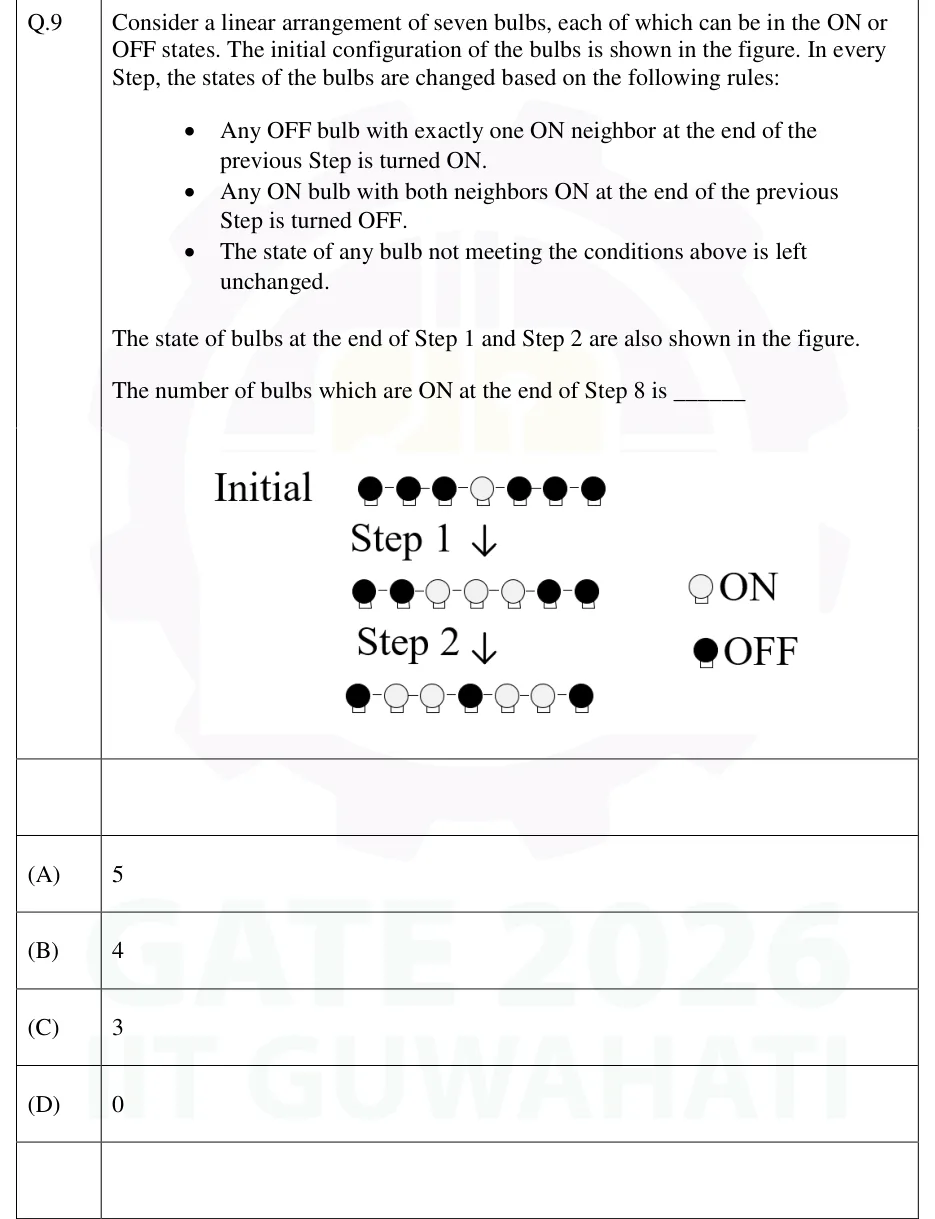
GATE 2026 EE GA question 9: Three horizontal rows of seven bulb icons joined by short dashes, stacked vertically.Tap to open full size
Figure from the GATE 2026 EE paper. It is part of the question.
Figure description

Three horizontal rows of seven bulb icons joined by short dashes, stacked vertically. A legend on the right shows a hollow (white) bulb labelled 'ON' and a filled (black) bulb labelled 'OFF'. Row 1, labelled 'Initial' on its left: black, black, black, white, black, black, black (only the 4th bulb ON). Below it the label 'Step 1' with a downward arrow. Row 2: black, black, white, white, white, black, black (bulbs 3, 4, 5 ON). Below it the label 'Step 2' with a downward arrow. Row 3: black, white, white, black, white, white, black (bulbs 2, 3, 5, 6 ON).

  1. (A)

    5

  2. (B)

    4

  3. (C)

    3

  4. (D)

    0

Answer and solution

ANSWER

At the end of Step 8 the bulbs read ON, OFF, ON, OFF, ON, OFF, ON (). That is 4 bulbs ON, option (B).

Official answer: BSource: Official answer key, GATE 2026 EE (IIT Guwahati)

  1. Read the legend carefully: a hollow bulb is ON and a filled bulb is OFF. Write each row as a string of seven digits, bulbs 1 to 7 from left to right, with 1 = ON and 0 = OFF. Initial: .

  2. All bulbs update at the same time, using the states at the end of the previous Step. An end bulb (bulb 1 or bulb 7) has only one neighbour. It can turn ON when that neighbour is ON, since it then has exactly one ON neighbour, but it can never have both neighbours ON.

  3. Check this reading of the rules against the figure. Step 1: bulbs 3 and 5 each have exactly one ON neighbour (bulb 4), so they turn ON. Bulb 4 has no ON neighbour, so it is unchanged. Result: . Step 2: bulbs 2 and 6 each have exactly one ON neighbour, so they turn ON, and bulb 4 has both neighbours ON, so it turns OFF. Result: . Both rows match the figure, so the reading is confirmed.

  4. Step 3 (from ): end bulbs 1 and 7 each have their only neighbour ON, which is exactly one ON neighbour, so they turn ON. Bulb 4 is OFF with two ON neighbours, not exactly one, so it stays OFF. No ON bulb has both neighbours ON. Result: .

  5. Step 4 (from ): bulb 2 (neighbours 1 and 3 both ON) and bulb 6 (neighbours 5 and 7 both ON) turn OFF. Bulb 4 is still OFF with two ON neighbours, so it stays OFF. Bulbs 1, 3, 5 and 7 do not have both neighbours ON, so they stay ON. Result: .

  6. Step 5 (from ): each OFF bulb (2, 4, 6) has two ON neighbours, so none of them turns ON. Each ON bulb (1, 3, 5, 7) has no ON neighbour, so none of them turns OFF. Result: again. The pattern has reached a fixed point.

  7. Because the state no longer changes, Steps 6, 7 and 8 also give . The number of bulbs ON at the end of Step 8 is , which is option (B).

KEY IDEA

Update every bulb at the same time from the previous Step's states, and first check that your reading of the rules reproduces the given Step 1 and Step 2 rows. Then keep stepping until the pattern stops changing. Here it settles by Step 4 at , where every OFF bulb has two ON neighbours (not exactly one) and every ON bulb has no ON neighbours, so nothing can change after that.

WATCH OUT FOR

(1) Swapping the legend. Hollow is ON and filled is OFF. With the colours swapped, the initial row is and the rules give as the next row, which does not match the figure's Step 1. (2) Reading "exactly one ON neighbour" as "at least one". Bulb 4 then turns ON in Step 3, and the sequence drifts to a different count. (3) Updating bulbs one at a time from left to right instead of all together from the previous Step's states. (4) Stopping at Step 3, which has 6 bulbs ON.

From the GATE 2026 EE paper. Every question of this paper · Download the full paper · All 41 Reasoning questions, with notes

More Reasoning questions