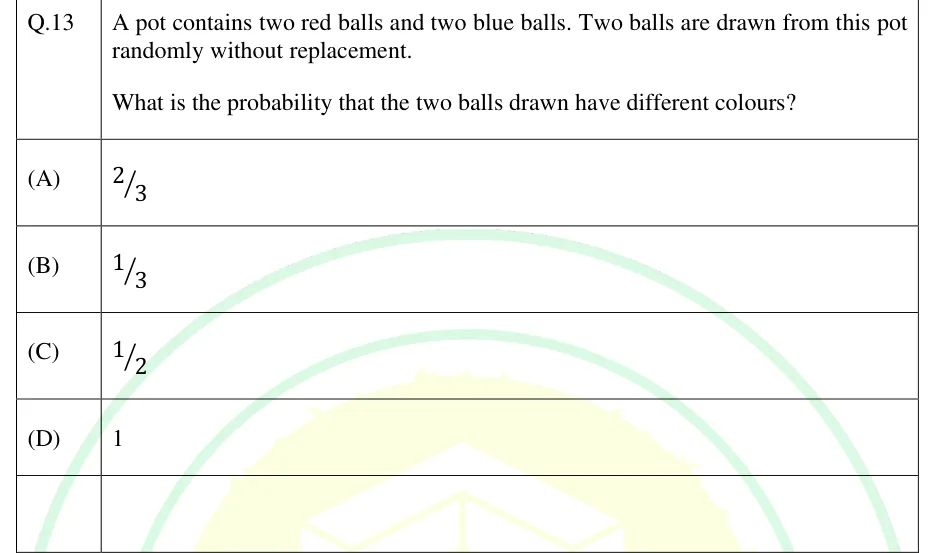
A pot contains two red balls and two blue balls. Two balls are drawn from this pot randomly without replacement.
What is the probability that the two balls drawn have different colours?
- (A)
- (B)
- (C)
- (D)

A pot contains two red balls and two blue balls. Two balls are drawn from this pot randomly without replacement.
What is the probability that the two balls drawn have different colours?
ANSWER
The probability that the two balls drawn have different colours is , which is option (A).
Official answer: ASource: Official answer key, GATE 2025 EC (IIT Roorkee)
Sample space: choosing any 2 of the 4 balls, with order ignored, gives equally likely pairs.
Favourable outcomes: one red ball and one blue ball. By the multiplication rule there are such pairs.
Classical probability: .
Check with the complement: , so .
Check by drawing one ball at a time: whatever colour the first ball is, 2 of the 3 balls left are the other colour, so . This matches option (A).
KEY IDEA
Without replacement, the first ball can be anything. What matters is the second draw: 3 balls are left and 2 of them are the other colour, so the probability is . You get the same answer by counting unordered pairs, .
WATCH OUT FOR
One mistake is to treat the draws as if they were with replacement, which gives , option (C). Another is to use the ordered count (4 ordered red-blue pairs, only one colour order) over the unordered total, or to leave out the factor 2 for the two orders in the sequential method (, option (B)).
From the GATE 2025 EC paper. Every question of this paper · Download the full paper · All 33 Probability & statistics questions, with notes