IAE Academy

GATE 2026 CS1 Q.11: solution and answer

GATE 2026 · CS1Q.11 · 1 mark · MCQ

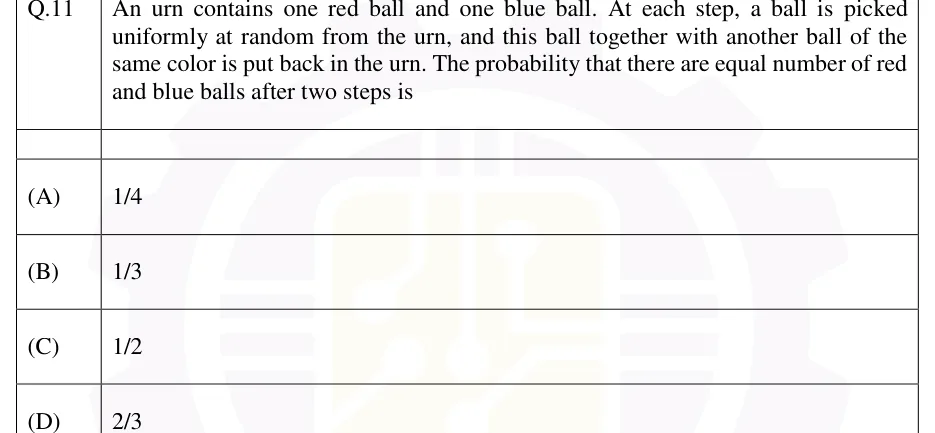
An urn contains one red ball and one blue ball. At each step, a ball is picked uniformly at random from the urn, and this ball together with another ball of the same color is put back in the urn. The probability that there are equal number of red and blue balls after two steps is

  1. (A)

    1/4

  2. (B)

    1/3

  3. (C)

    1/2

  4. (D)

    2/3

See the question in the paper

Answer and solution

ANSWER

The probability of equal red and blue balls after two steps is , option (B).

Official answer: BSource: Official answer key, GATE 2026 CS1 (IIT Guwahati)

  1. Each step adds one ball, so after two steps the urn holds balls. Equal numbers means exactly red and blue, so one step must add a red ball and the other a blue ball.

  2. Case 1, red then blue. Step 1: , and the urn becomes red, blue. Step 2: . The product is .

  3. Case 2, blue then red. By symmetry the urn becomes red, blue, and then . The product is .

  4. The two cases are mutually exclusive, so add them using the total probability rule: .

KEY IDEA

This is a Polya urn. After two draws the urn has 4 balls, so equality needs exactly one red addition and one blue addition. Multiply along each ordering using the urn's composition at each step, then add the two orderings.

WATCH OUT FOR

Using for the second draw as well, which gives in total. The urn changes after the first step: the drawn colour's count rises, so the second-draw probabilities are and , not .

From the GATE 2026 CS1 paper. Every question of this paper · Download the full paper · All 60 Probability & statistics questions, with notes

More Probability & statistics questions