
IAE Academy

GATE 2018 CS Q.44: solution and answer

GATE 2018 · CSQ.44 · 2 marks · NAT

Consider Guwahati (G) and Delhi (D) whose temperatures can be classified as high (H), medium (M) and low (L). Let P(H_G) denote the probability that Guwahati has high temperature. Similarly, P(M_G) and P(L_G) denote the probability of Guwahati having medium and low temperatures respectively. Similarly, we use P(H_D), P(M_D) and P(L_D) for Delhi.

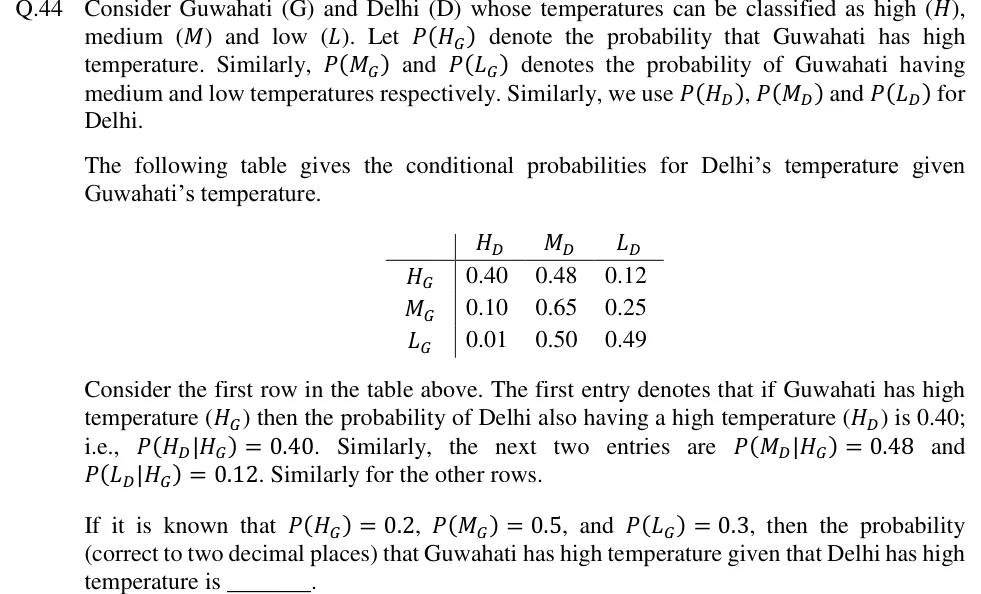
The following table gives the conditional probabilities for Delhi's temperature given Guwahati's temperature.

Consider the first row in the table above. The first entry denotes that if Guwahati has high temperature (H_G) then the probability of Delhi also having a high temperature (H_D) is 0.40; i.e., P(H_D | H_G) = 0.40. Similarly, the next two entries are P(M_D | H_G) = 0.48 and P(L_D | H_G) = 0.12. Similarly for the other rows.

If it is known that P(H_G) = 0.2, P(M_G) = 0.5, and P(L_G) = 0.3, then the probability (correct to two decimal places) that Guwahati has high temperature given that Delhi has high temperature is ________.
See the question in the paper

Answer and solution

ANSWER

The probability that Guwahati has high temperature given that Delhi has high temperature is about 0.60.

Official answer: 0.60 to 0.62Source: Official answer key, GATE 2018 CS (IIT Guwahati)

  1. We need . By Bayes' theorem, .

  2. Numerator: .

  3. Denominator, by total probability over Guwahati's three states: .

  4. The column of the table gives , and , so .

  5. Divide: .

  6. Rounded to two decimal places, the answer is .

KEY IDEA

The table gives and the question asks for the reverse direction, so use Bayes' theorem. Find the denominator by total probability over Guwahati's three states.

WATCH OUT FOR

Dividing by or by the row sum instead of . Another slip is answering , or forgetting that must add contributions from all three Guwahati states.

From the GATE 2018 CS paper. Every question of this paper · Download the full paper · All 60 Probability & statistics questions, with notes

More Probability & statistics questions