
IAE Academy

GATE 2026 EE Q.49: solution and answer

GATE 2026 · EEQ.49 · 2 marks · MCQ

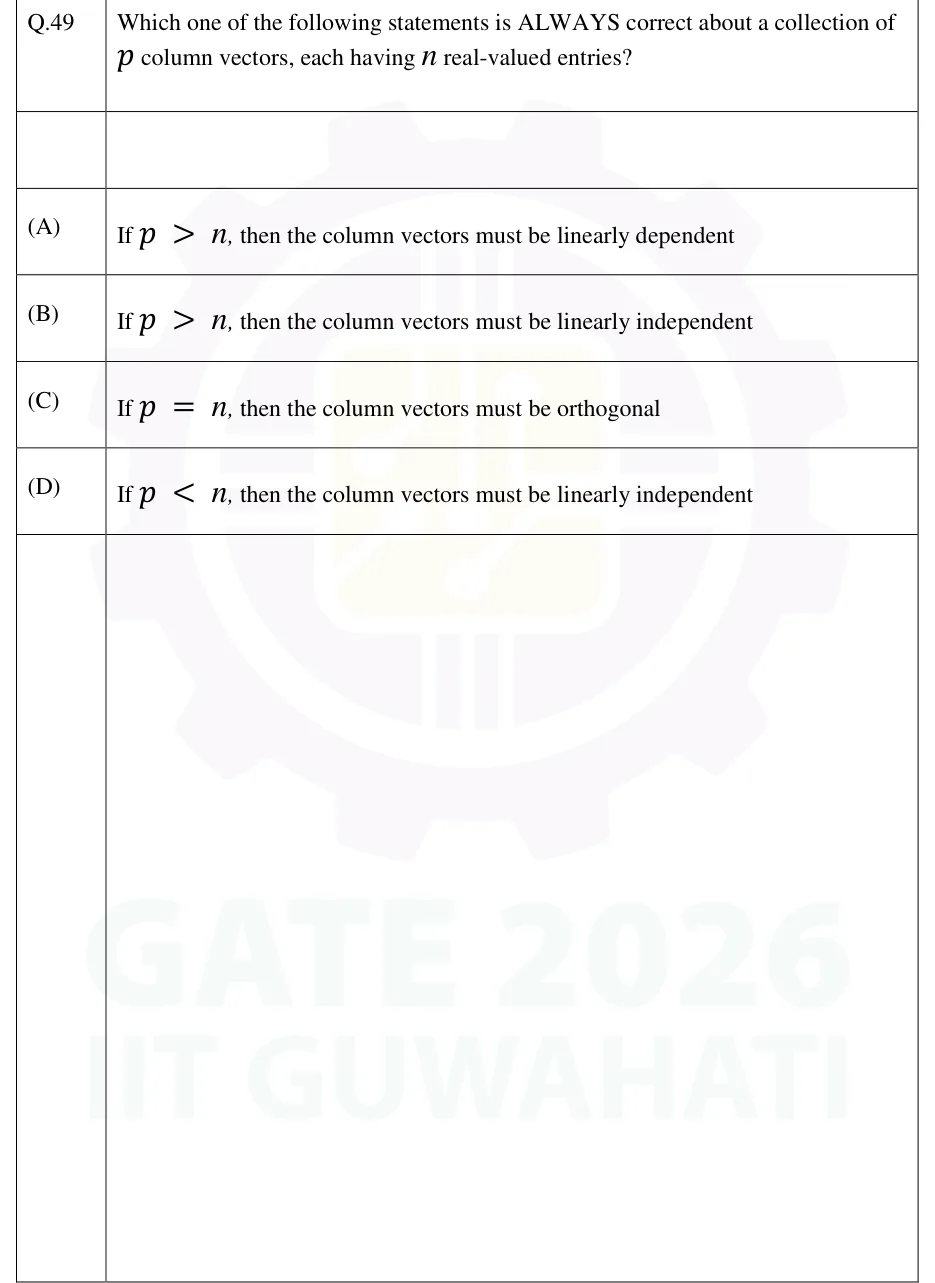
Which one of the following statements is ALWAYS correct about a collection of column vectors, each having real-valued entries?

  1. (A)

    If , then the column vectors must be linearly dependent

  2. (B)

    If , then the column vectors must be linearly independent
  3. (C)

    If , then the column vectors must be orthogonal

  4. (D)

    If , then the column vectors must be linearly independent

See the question in the paper

Answer and solution

ANSWER

(A): if , the column vectors must be linearly dependent.

Official answer: ASource: Official answer key, GATE 2026 EE (IIT Guwahati)

  1. Stack the vectors as the columns of an matrix . The vectors are linearly independent exactly when has only the trivial solution, that is, when .

  2. The rank is bounded by both dimensions: . Every vector lies in , which has dimension , so no more than of them can be independent.

  3. (A): if , then . So has a nontrivial solution (a homogeneous system with more unknowns, , than equations, ), and the vectors are dependent whatever they are. (A) is ALWAYS true.

  4. (B): by step 3, vectors in are never independent, so (B) is false for every choice of vectors. For example, in any three vectors are dependent.

  5. (C): take with and . Their dot product is , so they are not orthogonal, even though they are independent. Having does not force orthogonality, or even independence: and are dependent.

  6. (D): take with and . The second vector is twice the first, so they are dependent. Having only allows independence; it does not guarantee it.

  7. The only statement that holds for every choice of vectors is (A).

KEY IDEA

The vectors are the columns of an matrix, and . Independence needs , which is impossible when : cannot hold more than independent vectors. The reverse does not hold. allows independence but never guarantees it, and independence is a much weaker condition than orthogonality.

WATCH OUT FOR

Treating a necessary condition as a sufficient one. is necessary for independence but not sufficient, so (D) fails: a vector and a multiple of it are dependent in any dimension. Another mistake is confusing independence with orthogonality in (C). Orthogonal nonzero vectors are always independent, but independent vectors need not be orthogonal.

From the GATE 2026 EE paper. Every question of this paper · Download the full paper · All 46 Linear algebra questions, with notes

More Linear algebra questions