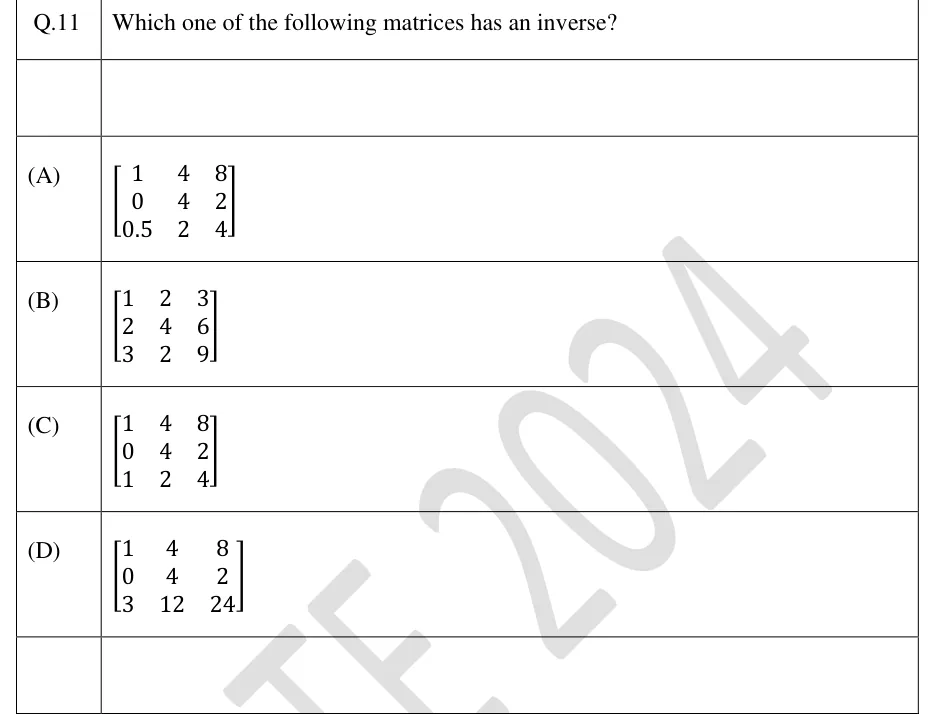
Which one of the following matrices has an inverse?
- (A)
- (B)
- (C)
- (D)

Which one of the following matrices has an inverse?
ANSWER
Option (C) is the only invertible matrix: its determinant is . In (A), (B) and (D) one row is a scalar multiple of another, so each of those determinants is zero.
Official answer: CSource: Official answer key, GATE 2024 EE (IISc Bengaluru)
Rule: a square matrix has an inverse if and only if . Equivalently, its rows must be linearly independent, so a row that is a multiple of another row makes the matrix singular.
(A): Row 3 is . So and the matrix is singular. (Check by expanding along Row 1: .)
(B): Row 2 is . So and the matrix is singular.
(D): Row 3 is . So and the matrix is singular.
(C): No row is a multiple of another. That alone does not prove the matrix is invertible, so compute the determinant by cofactor expansion along Row 1:
, so matrix (C) is non-singular and has an inverse. The answer is (C).
KEY IDEA
A square matrix is invertible exactly when its determinant is non-zero. A quick way to rule out options is to look for a row (or column) that is a scalar multiple of another, because that forces . For the one option left, compute the determinant to confirm it is non-zero.
WATCH OUT FOR
Picking (C) only because none of its rows is a multiple of another. Having no proportional pair of rows does not prove invertibility, since a row can still be a combination of two others. Always compute for the matrix you choose. Another slip is the sign pattern in the cofactor expansion. Getting the middle term wrong gives , which happens to be non-zero as well, so the error goes unnoticed.
From the GATE 2024 EE paper. Every question of this paper · Download the full paper · All 46 Linear algebra questions, with notes