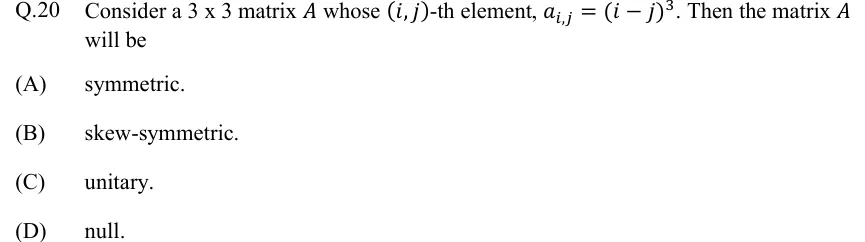
Consider a 3 x 3 matrix whose -th element, . Then the matrix will be
- (A)
symmetric.
- (B)
skew-symmetric.
- (C)
unitary.
- (D)
null.

Consider a 3 x 3 matrix whose -th element, . Then the matrix will be
symmetric.
skew-symmetric.
unitary.
null.
ANSWER
is skew-symmetric, because , so . Option (B).
Official answer: BSource: Official answer key, GATE 2022 EE (IIT Kharagpur)
Swap the indices in the general term: . The sign carries through because the power is odd.
So for every , which means . That is the definition of a skew-symmetric matrix. Setting gives , so every diagonal entry is , as a skew-symmetric matrix needs.
Check by writing the matrix out. , , , the entries below the diagonal are their negatives, and every diagonal entry is :
It is not symmetric: but , so . It is not null: it has non-zero entries.
It is not unitary. For a skew-symmetric matrix of odd order, , so and is singular. A unitary matrix is always invertible, since . You can also see it directly: the first column has length , but every column of a unitary matrix has length .
So is skew-symmetric, which is option (B).
KEY IDEA
If the entry is an odd function of , swapping and flips its sign, so and the matrix is skew-symmetric. An even function of , such as or , would make it symmetric instead. You never need to write the matrix out. Looking only at the parity of the power is enough.
WATCH OUT FOR
Treating as if it were or , which leads to 'symmetric'. The cube keeps the sign, so while . A second trap is choosing 'null' because every diagonal entry is : a zero diagonal is only what skew-symmetry forces, and the off-diagonal entries are non-zero.
From the GATE 2022 EE paper. Every question of this paper · Download the full paper · All 46 Linear algebra questions, with notes