IAE Academy

GATE 2026 EE Q.15: solution and answer

GATE 2026 · EEQ.15 · 1 mark · MCQ

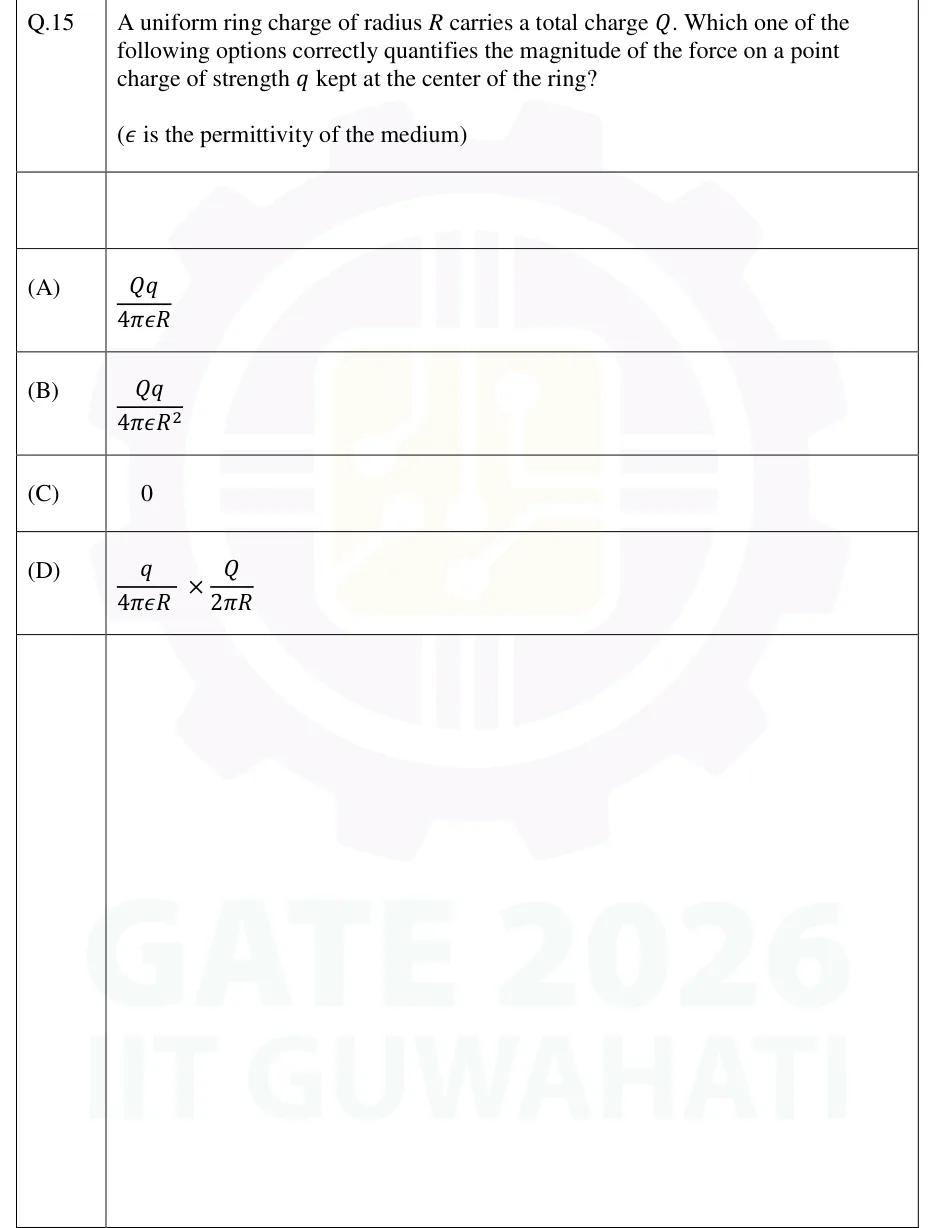
A uniform ring charge of radius carries a total charge . Which one of the following options correctly quantifies the magnitude of the force on a point charge of strength kept at the center of the ring?

( is the permittivity of the medium)

  1. (A)

  2. (B)

  3. (C)

  4. (D)

See the question in the paper

Answer and solution

ANSWER

The force on the point charge at the centre of the uniformly charged ring is zero. Answer: (C).

Official answer: CSource: Official answer key, GATE 2026 EE (IIT Guwahati)

  1. Put the ring in the -plane, centred at the origin. The charge is spread uniformly along the circumference , so the line charge density is .

  2. Take a charge element at angle , i.e. at position with . By Coulomb's law its field at the centre has magnitude and points from the element towards the centre, i.e. along :

  3. Superpose over the whole ring. Because changes direction with , write it in the fixed Cartesian unit vectors before integrating:

    since .

  4. Symmetry check: every element at angle has an equal partner at , diametrically opposite. Their fields at the centre are equal in magnitude and opposite in direction, so they cancel in pairs. Cross-check with the standard on-axis result for a ring, , which is at .

  5. Force on the point charge: , so for any , , and .

  6. Checking the options: (A) has the units of energy. It is the potential energy of the point charge, where is the (non-zero) potential at the centre. It is not a force. (B) is what you get by adding the magnitudes of all the elemental forces and ignoring their directions. (D) does have the units of force ( is in , is in , and ), but it is non-zero, while the vector sum is exactly zero. Only (C) is correct.

KEY IDEA

Electric field is a vector. At the centre of a uniformly charged ring, each charge element is cancelled by the element diametrically opposite it, so and . Potential is a scalar, so nothing cancels: at the centre is not zero.

WATCH OUT FOR

Mixing up potential and field. Students pick (A), which is the potential energy at the centre and not a force, or (B), which adds the magnitudes of the elemental forces as if all of them pointed the same way. (D) looks convincing because it does have the units of force, but symmetry forces the vector sum to be exactly zero.

From the GATE 2026 EE paper. Every question of this paper · Download the full paper · All 23 Electrostatics questions, with notes

More Electrostatics questions