IAE Academy

GATE 2025 EE Q.45: solution and answer

GATE 2025 · EEQ.45 · 2 marks · MCQ

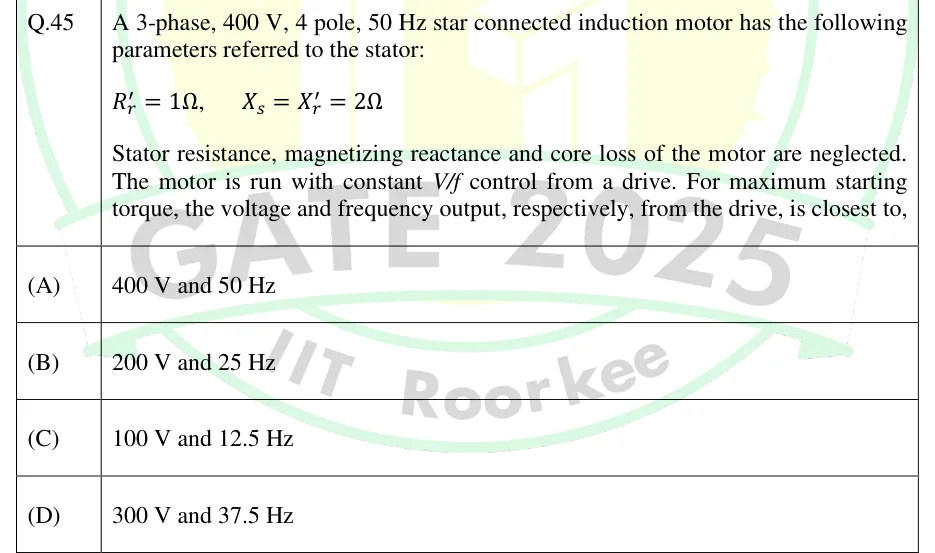
A 3-phase, 400 V, 4 pole, 50 Hz star connected induction motor has the following parameters referred to the stator: , . Stator resistance, magnetizing reactance and core loss of the motor are neglected. The motor is run with constant V/f control from a drive. For maximum starting torque, the voltage and frequency output, respectively, from the drive, is closest to,

  1. (A)

    400 V and 50 Hz

  2. (B)

    200 V and 25 Hz

  3. (C)

    100 V and 12.5 Hz

  4. (D)

    300 V and 37.5 Hz

See the question in the paper

Answer and solution

ANSWER

The correct answer is option (C): 100 V and 12.5 Hz.

Official answer: CSource: Official answer key, GATE 2025 EE (IIT Roorkee)

  1. Neglecting stator resistance, the magnetizing branch and core loss, the per-phase equivalent circuit reduces to a single series loop: supply phasor in series with the total leakage reactance and the referred rotor resistance . The torque is where is the total leakage reactance referred to the stator.

  2. Maximizing with respect to slip (for fixed , ) gives the standard result

  3. At rated frequency (50 Hz): .

  4. Under constant V/f (scalar) control, the leakage reactance scales linearly with the drive's output frequency, while (a resistance) does not:

  5. Starting always corresponds to slip . For maximum torque to occur exactly at starting, the peak-torque slip must equal 1:

  6. Solving:

  7. Constant V/f ratio, taken from the rated nameplate values (the ratio is the same whether line or phase quantities are used):

  8. Therefore

  9. This matches option (C): 100 V and 12.5 Hz.

KEY IDEA

See keyIdea field above.

WATCH OUT FOR

Assuming must be evaluated at the rated 50 Hz reactance (giving , not 1) and then either stopping there or wrongly forcing slip = 1 into the rated-frequency torque expression instead of solving for the frequency at which the reactance shrinks enough to make ; a second common slip is treating as scaling with frequency along with the reactance, which cancels the frequency dependence and gives no solution.

From the GATE 2025 EE paper. Every question of this paper · Download the full paper · All 17 Induction machines questions, with notes

More Induction machines questions