IAE Academy

GATE 2025 CS2 Q.42: solution and answer

GATE 2025 · CS2Q.42 · 2 marks · MSQ

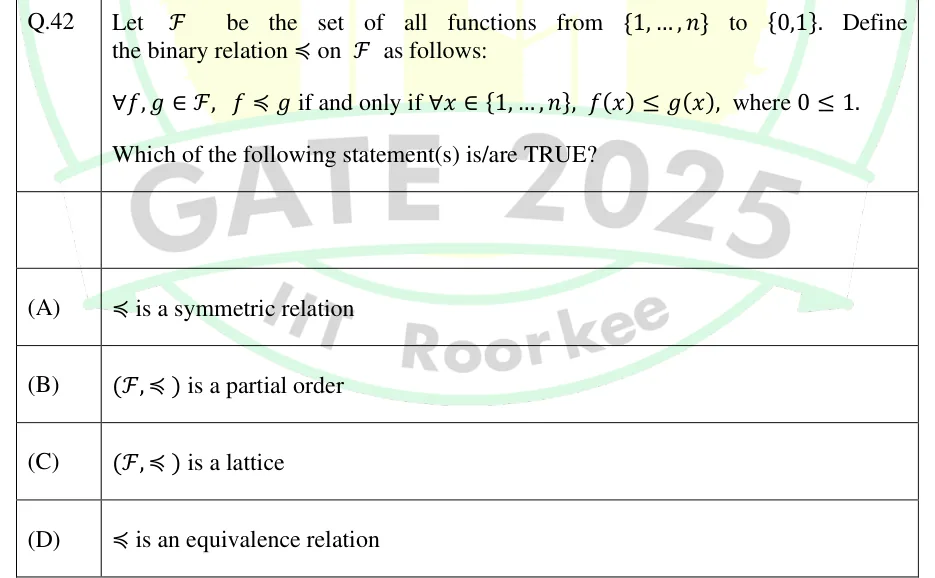
Let be the set of all functions from to . Define the binary relation on as follows:

if and only if , where .

Which of the following statement(s) is/are TRUE?

  1. (A)

    is a symmetric relation

  2. (B)

    is a partial order

  3. (C)

    is a lattice

  4. (D)

    is an equivalence relation

See the question in the paper

Answer and solution

ANSWER

The true statements are (B) and (C): the relation is a partial order, and it is a lattice.

Official answer: B, CSource: Official answer key, GATE 2025 CS2 (IIT Roorkee)

  1. Each is a bit vector , and means in every position. This is the componentwise order on .

  2. Reflexive: for all , so .

  3. Antisymmetric: if and , then and for every . So for every , and .

  4. Transitive: if and , then for all , so . The relation is reflexive, antisymmetric and transitive, so is a partial order. (B) is true.

  5. Lattice: for any define and . Both take values in , so both lie in . The first is an upper bound of and , and any upper bound has at each , so it is the least upper bound. Dually, the second is the greatest lower bound. Every pair has a join and a meet, so is a lattice (the Boolean lattice ). (C) is true.

  6. Symmetric fails: take and . Then , but because . So (A) is false.

  7. An equivalence relation must be symmetric, and this one is not, so (D) is false. The true statements are (B) and (C).

KEY IDEA

Comparing bit vectors position by position gives the componentwise order on . It is a partial order, and position-wise max and min give the join and meet, so it is the Boolean lattice .

WATCH OUT FOR

Treating the relation as symmetric or an equivalence because "" looks like "=", or checking only the partial-order axioms and forgetting that every pair needs a join and a meet.

From the GATE 2025 CS2 paper. Every question of this paper · Download the full paper · All 8 Sets & relations questions, with notes

More Sets & relations questions