IAE Academy

GATE 2023 CS Q.51: solution and answer

GATE 2023 · CSQ.51 · 2 marks · MSQ

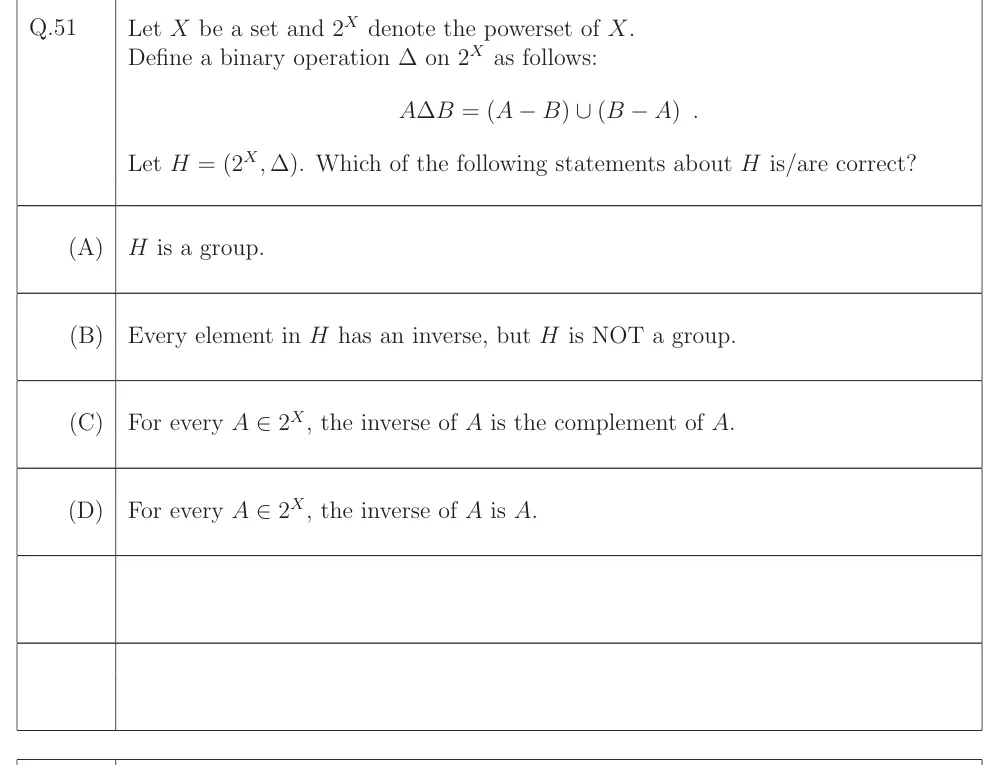
Let be a set and denote the powerset of . Define a binary operation on as follows:

Let . Which of the following statements about is/are correct?

  1. (A)

    is a group.

  2. (B)

    Every element in has an inverse, but is NOT a group.

  3. (C)

    For every , the inverse of is the complement of .

  4. (D)

    For every , the inverse of is .

See the question in the paper

Answer and solution

ANSWER

Options (A) and (D) are correct: is a group, and every element is its own inverse.

Official answer: A, DSource: Official answer key, GATE 2023 CS (IIT Kanpur)

  1. Closure: is built from elements of , so it is a subset of and lies in .

  2. Associativity: an element lies in exactly when it belongs to exactly one of , that is, to an odd number of them. For three sets, exactly when the number of sets among and containing is odd. This happens exactly when lies in an odd number of : if is in , it must lie in an even number of ; if not, in an odd number. The same count describes . Both sides contain exactly the elements that belong to an odd number of , so is associative.

  3. Identity: , and by symmetry. So is the identity.

  4. Inverse: . Every element is its own inverse, so (D) is true.

  5. Closure, associativity, identity and inverses all hold, so is a group (an abelian group, since the definition is symmetric in and ). (A) is true and (B) is false.

  6. Check (C): the complement gives . This equals the identity only when . For example, with and , the complement is and . So (C) is false in general.

  7. Correct options: (A) and (D).

KEY IDEA

Symmetric difference is addition mod 2 on indicator vectors: is a group with identity , and every element is its own inverse because .

WATCH OUT FOR

Confusing the inverse with the complement. , not , so the complement is not the inverse. Also, doubting associativity because the operation looks unusual.

From the GATE 2023 CS paper. Every question of this paper · Download the full paper · All 7 Groups questions, with notes

More Groups questions