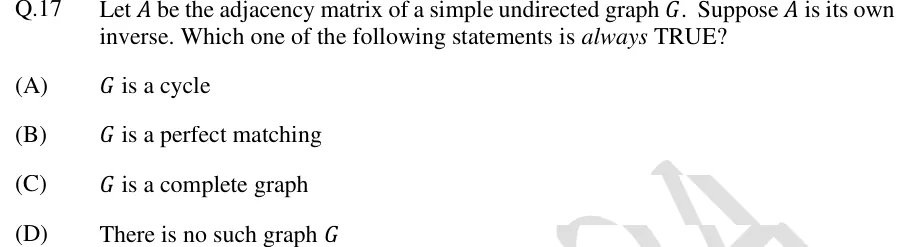
Let be the adjacency matrix of a simple undirected graph . Suppose is its own inverse. Which one of the following statements is always TRUE?
- (A)
is a cycle
- (B)
is a perfect matching
- (C)
is a complete graph
- (D)
There is no such graph

Let be the adjacency matrix of a simple undirected graph . Suppose is its own inverse. Which one of the following statements is always TRUE?
is a cycle
is a perfect matching
is a complete graph
There is no such graph
ANSWER
Option (B): is a perfect matching.
Official answer: BSource: Official answer key, GATE 2024 CS2 (IISc Bengaluru)
is its own inverse, so .
For a simple undirected graph, is symmetric with zero diagonal. Then is the number of common neighbours of and . For it equals .
Diagonal entries: , so every vertex has degree exactly 1.
Off-diagonal entries: for . This holds automatically when every degree is 1, because two distinct vertices cannot share a neighbour (that neighbour would have degree at least 2).
A graph in which every vertex has degree 1 is a set of disjoint edges, that is, a perfect matching.
Such graphs exist. For , and , so (D) is false.
A cycle has every degree equal to 2, and for has every degree equal to . Both violate degree 1, so (A) and (C) are not true. Only (B) always holds.
KEY IDEA
forces every vertex degree to be 1 (the diagonal of is the degree). A graph with all degrees 1 is a perfect matching, and the off-diagonal zeros then hold automatically.
WATCH OUT FOR
Choosing (D) because "an inverse adjacency matrix looks impossible". Check , whose adjacency matrix is its own inverse. Another slip is forgetting that is the degree, not 0 or 1 by default.
From the GATE 2024 CS2 paper. Every question of this paper · Download the full paper · All 14 Graph theory questions, with notes