
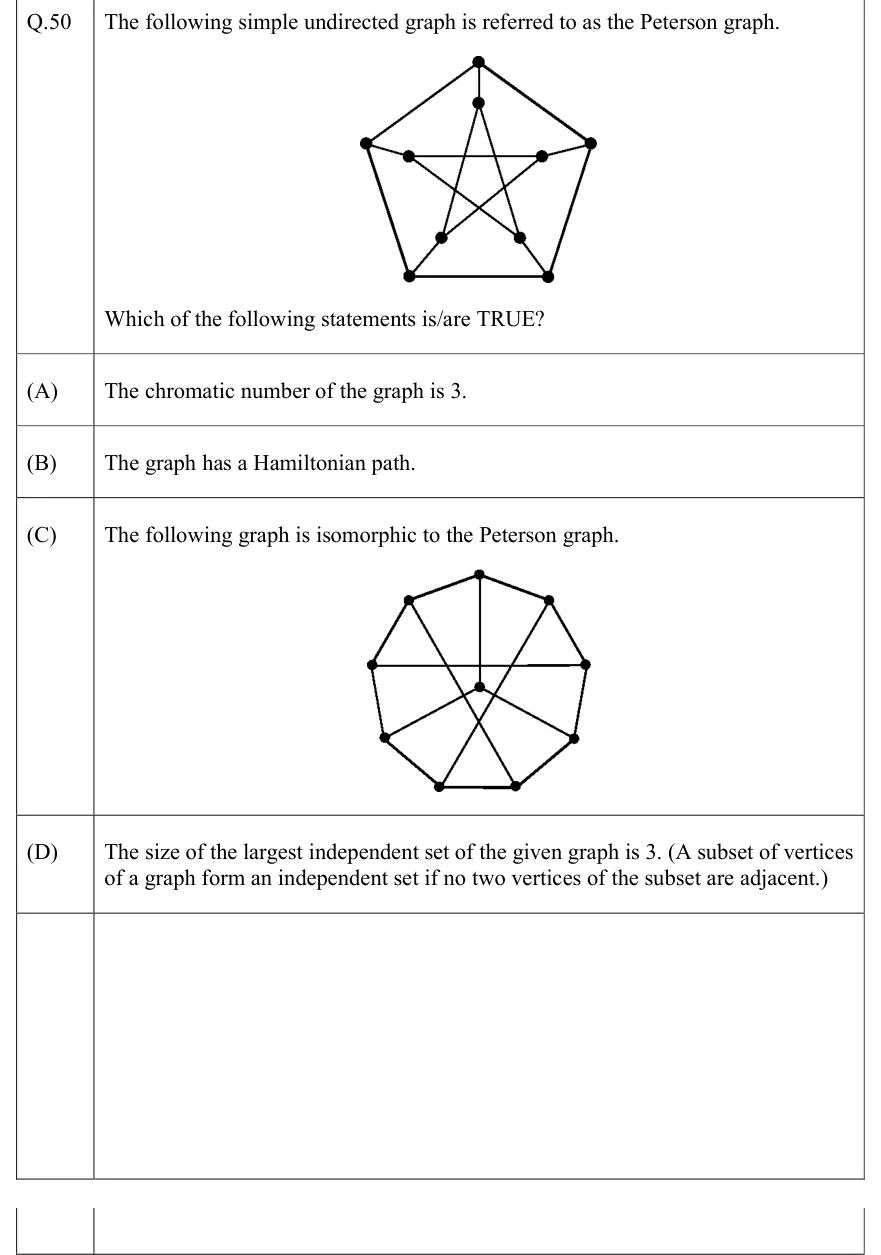
The following simple undirected graph is referred to as the Peterson graph. Which of the following statements is/are TRUE?
 Tap to open full size
Figure description
Top figure: the Peterson graph drawn as an outer regular pentagon with 5 vertices and an inner pentagram (five-pointed star) with 5 vertices. Each outer vertex is joined to the nearest inner star tip; the inner 5 vertices are joined as a pentagram (each inner vertex to the two inner vertices two steps away). 10 vertices, 15 edges. Option (C) figure: a graph on 10 vertices: 9 vertices on the boundary of a nonagon (top, upper-right, right, lower-right, bottom-right, bottom-left, lower-left, left, upper-left), joined in a 9-cycle, plus one centre vertex. Chords: top to centre (vertical line), left to right (horizontal line), upper-left to bottom-right, upper-right to bottom-left, and centre to lower-left and centre to lower-right. 15 edges in all.
- (A)
The chromatic number of the graph is 3.
- (B)
The graph has a Hamiltonian path.
- (C)
The following graph is isomorphic to the Peterson graph. [Figure — a 9-cycle of boundary vertices plus a centre vertex, with six chords as described]
- (D)
The size of the largest independent set of the given graph is 3. (A subset of vertices of a graph form an independent set if no two vertices of the subset are adjacent.)