
IAE Academy

GATE 2024 CS1 Q.51: solution and answer

GATE 2024 · CS1Q.51 · 2 marks · MSQ

The chromatic number of a graph is the minimum number of colours used in a proper colouring of the graph. Let be any graph with vertices and chromatic number . Which of the following statements is/are always TRUE?

  1. (A)

    contains a complete subgraph with vertices

  2. (B)

    contains an independent set of size at least

  3. (C)

    contains at least edges

  4. (D)

    contains a vertex of degree at least
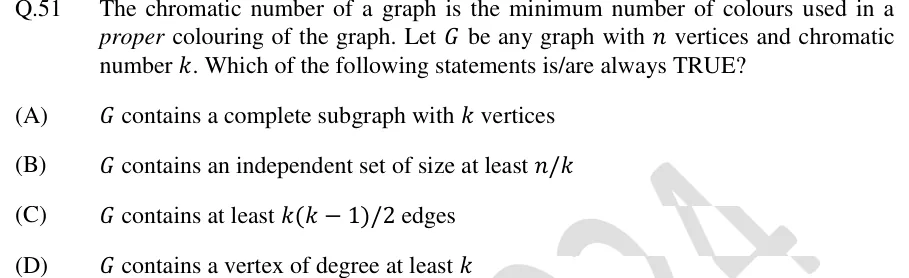
See the question in the paper

Answer and solution

ANSWER

The statements that are always true are (B) and (C).

Official answer: B, CSource: Official answer key, GATE 2024 CS1 (IISc Bengaluru)

  1. Take a proper colouring of with exactly colours, where . Each colour class is an independent set, and the classes partition the vertices.

  2. (A) Test with the odd cycle : , but has no triangle, so it has no . (A) is not always true.

  3. (B) The classes cover vertices, so by the pigeonhole principle one class has at least vertices. That class is an independent set. (B) is always true.

  4. (C) Suppose two colour classes had no edge between them. Merging them would give a proper colouring with colours, which contradicts .

  5. So every pair of the classes has at least one edge between them. The pairs of classes number , and the edges counted for different pairs are distinct. Hence has at least edges. (C) is always true.

  6. (D) Test with : , but every vertex has degree . (D) is not always true.

  7. Hence the correct options are (B) and (C).

KEY IDEA

In a colouring with colours, each colour class is an independent set. By pigeonhole, the largest class has at least vertices. Minimality of forces an edge between every two classes, so has at least edges.

WATCH OUT FOR

Assuming a high chromatic number forces a large clique (A) or a high-degree vertex (D). Odd cycles have with no triangle, and has maximum degree only .

From the GATE 2024 CS1 paper. Every question of this paper · Download the full paper · All 14 Graph theory questions, with notes

More Graph theory questions