
IAE Academy

GATE 2026 CS1 Q.37: solution and answer

GATE 2026 · CS1Q.37 · 2 marks · MCQ

Consider a 2-bit saturating up/down counter that performs the saturating up count when the input P is 0, and the saturating down count when P is 1. The Next State table of the counter is as shown. The counter is built as a synchronous sequential circuit using D flip-flops. Which one of the following options corresponds to the expressions for the inputs of the D flip-flops, D1 and D0?
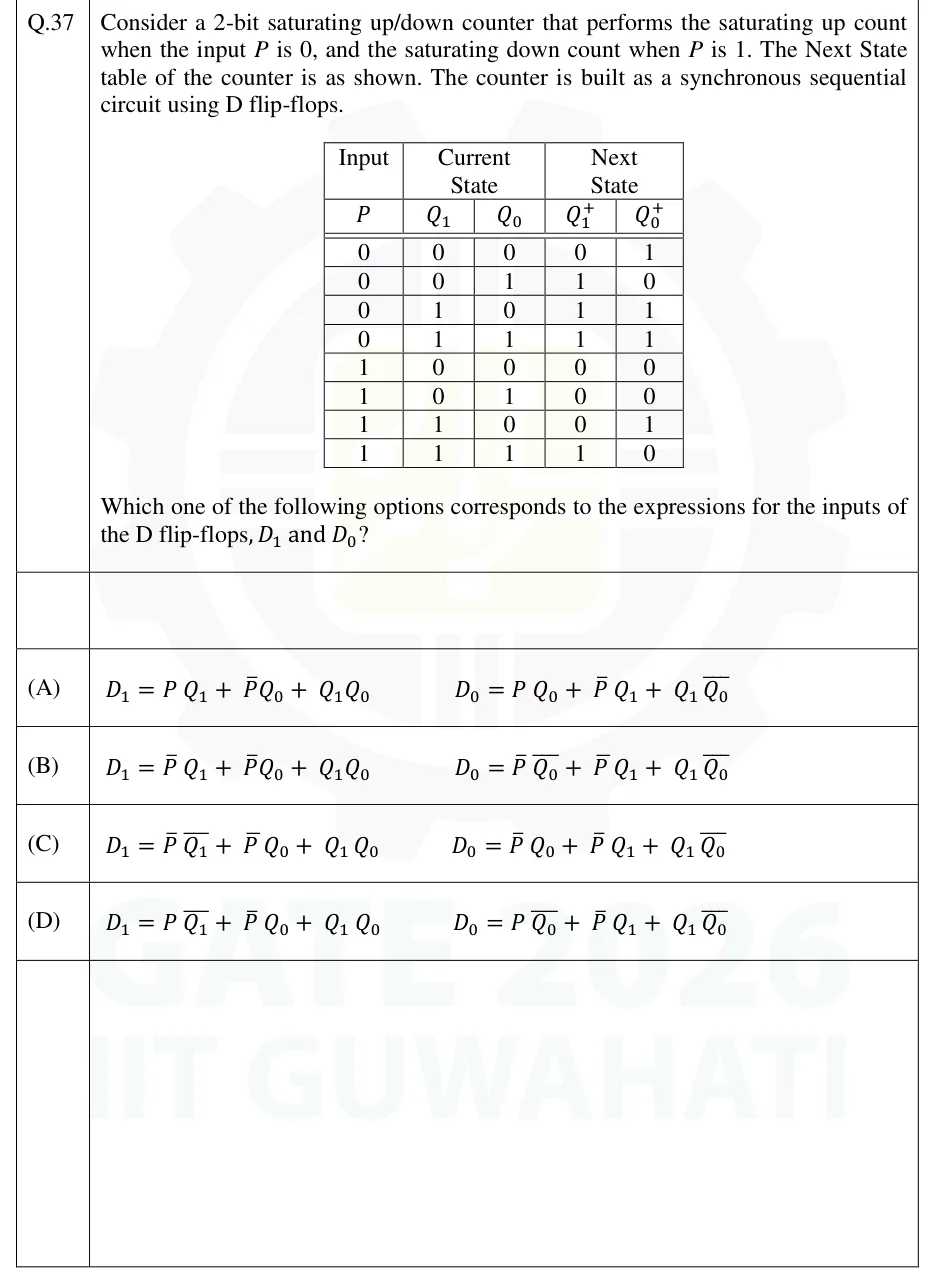
GATE 2026 CS1 question 37: Next-state table with columns P, Q1, Q0 (inputs/current state) and Q1+, Q0+ (next state).Tap to open full size
Figure from the GATE 2026 CS1 paper. It is part of the question.
Figure description

Next-state table with columns P, Q1, Q0 (inputs/current state) and Q1+, Q0+ (next state). Rows (P Q1 Q0 -> Q1+ Q0+): 0 0 0 -> 0 1; 0 0 1 -> 1 0; 0 1 0 -> 1 1; 0 1 1 -> 1 1; 1 0 0 -> 0 0; 1 0 1 -> 0 0; 1 1 0 -> 0 1; 1 1 1 -> 1 0.

  1. (A)

    D1 = P Q1 + P̄ Q0 + Q1 Q0 ; D0 = P Q0 + P̄ Q1 + Q1 Q̄0

  2. (B)

    D1 = P̄ Q1 + P̄ Q0 + Q1 Q0 ; D0 = P̄ Q̄0 + P̄ Q1 + Q1 Q̄0

  3. (C)

    D1 = P̄ Q̄1 + P̄ Q0 + Q1 Q0 ; D0 = P̄ Q0 + P̄ Q1 + Q1 Q̄0

  4. (D)

    D1 = P Q̄1 + P̄ Q0 + Q1 Q0 ; D0 = P Q̄0 + P̄ Q1 + Q1 Q̄0

Answer and solution

ANSWER

Option (B): and .

Official answer: BSource: Official answer key, GATE 2026 CS1 (IIT Guwahati)

  1. For a D flip-flop the input equals the next state, so and .

  2. Read from the table. For , with , it is , which is . For it is , which is .

  3. Combine: . The term is already true wherever is. At it is contained in , so adding it changes nothing. Replacing by therefore gives .

  4. Read . For it is for , which is . For it is , which is .

  5. Combine: . At the term is contained in , so replacing by changes nothing. Hence .

  6. Check against the table. At , : the terms vanish and , so , as in the table. At , : the terms vanish and , so , as in the table.

  7. The pair matches option (B). The others fail on a single row. (A) gives at , , but the table has . (C) gives at , , but the table has . (D) gives at , , but the table has .

KEY IDEA

For a D flip-flop, equals the next state. Split the next-state column by , write each half as a small expression in , and add a redundant consensus term to match the options.

WATCH OUT FOR

Using in place of for the up-count half, which swaps the up and down behaviour. Another slip is misreading the column, which toggles on up count and is not a simple copy of .

From the GATE 2026 CS1 paper. Every question of this paper · Download the full paper · All 37 Sequential questions, with notes

More Sequential questions