IAE Academy

ISRO CS 2023 Q.35: solution and answer

ISRO 2023 · CSQ.35 · 1 mark · MCQ

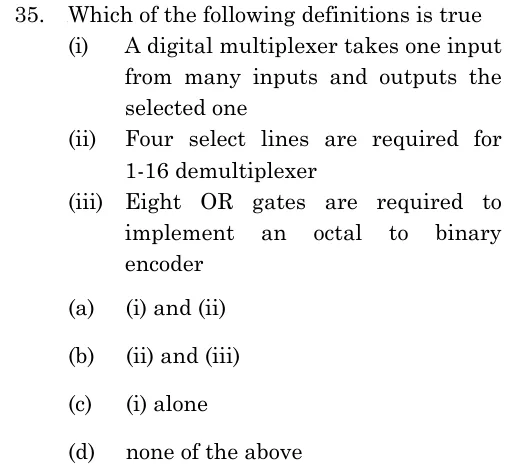
Which of the following definitions is true?
(i) A digital multiplexer takes one input from many inputs and outputs the selected one
(ii) Four select lines are required for 1-16 demultiplexer
(iii) Eight OR gates are required to implement an octal to binary encoder

  1. (A)

    (i) and (ii)

  2. (B)

    (ii) and (iii)

  3. (C)

    (i) alone

  4. (D)

    none of the above

See the question in the paper

Answer and solution

ANSWER

Option (a): statements (i) and (ii) are true, and (iii) is false.

Official answer: ASource: ISRO's revised and final answer key of 16 February 2024

  1. Statement (i): a multiplexer has many data inputs, some select lines and one output. The select lines choose one input and it appears at the output. So (i) is true.

  2. Statement (ii): a 1-to- demultiplexer needs select lines to choose which output receives the data. For , , so four select lines are needed and (ii) is true.

  3. Statement (iii): an octal-to-binary encoder has 8 inputs and 3 outputs . Each output bit is the OR of the inputs whose binary code has a 1 in that bit position.

  4. This takes three OR gates, each with four inputs, not eight. So (iii) is false.

  5. Statements (i) and (ii) are true and (iii) is false, so the correct option is (a).

KEY IDEA

A multiplexer picks one of many inputs. A 1-to- demultiplexer needs select lines. An -to- encoder needs only OR gates, one per output bit.

WATCH OUT FOR

Counting one OR gate per input, which gives 8 gates for an octal encoder. The gates are one per output bit, so 3 are needed. Another slip is taking 16 select lines for a 1-to-16 demultiplexer instead of .

From the ISRO CS 2023 paper. Every question of this paper · The full paper (PDF, ISRO) · All 6 ISRO Combinational questions, with notes

More ISRO Combinational questions