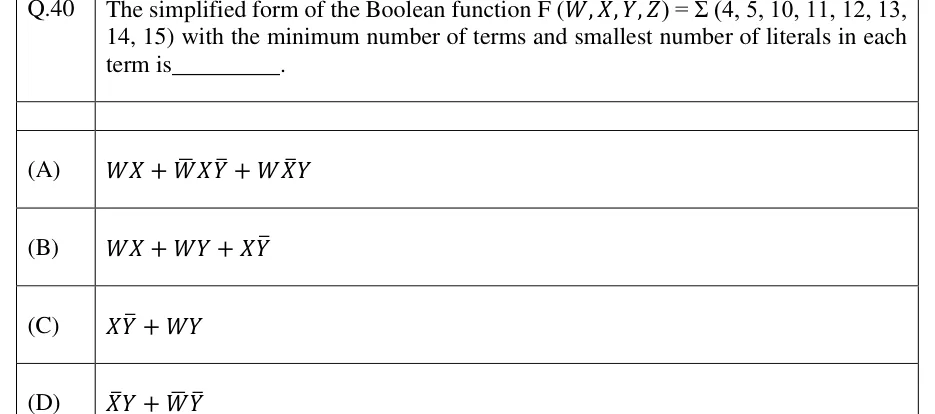
The simplified form of the Boolean function with the minimum number of terms and smallest number of literals in each term is ________.
- (A)
- (B)
- (C)
- (D)

The simplified form of the Boolean function with the minimum number of terms and smallest number of literals in each term is ________.
ANSWER
The minimal sum of products is , which is option (C).
Official answer: CSource: Official answer key, GATE 2023 IN (IIT Kanpur)
Write the minterms in binary, with as the MSB: , , , , , , , . Complement is written with an overline throughout, e.g. .
First quad: . All four have and , while and take every combination. This quad gives .
Second quad: . All four have and , while and take every combination. This quad gives .
Coverage and minimality. is exactly the eight given minterms, so covers with nothing extra. Both terms are essential prime implicants: minterm has and , so only covers it, and minterm has , so only covers it. No single literal can equal . would also include and , and would include and , none of which are in . So no implicant has fewer than 2 literals, and fewer than 2 terms is impossible.
Therefore This is 2 terms of 2 literals each.
Eliminate the other options. (A) covers , which equals , but it uses 3 terms, two of them with 3 literals, so it is not minimal. (B) adds , which is redundant: is already covered by the two quads. This is the consensus theorem, . (D) is true at minterm through , and is not in , so (D) is a different function.
Answer: (C) .
KEY IDEA
Plot the 8 minterms on a 4-variable K-map. They form exactly two non-overlapping quads: gives and gives . Both are essential prime implicants, and together they cover every minterm. The third prime implicant, , is the consensus of these two and is redundant.
WATCH OUT FOR
Choosing (B) because the quad () is a valid prime implicant. It is the consensus term of and , so it adds no coverage. Choosing (A) is the same kind of error: it describes the correct function but is not the minimal form the question asks for.
From the GATE 2023 IN paper. Every question of this paper · Download the full paper · All 22 Boolean logic questions, with notes