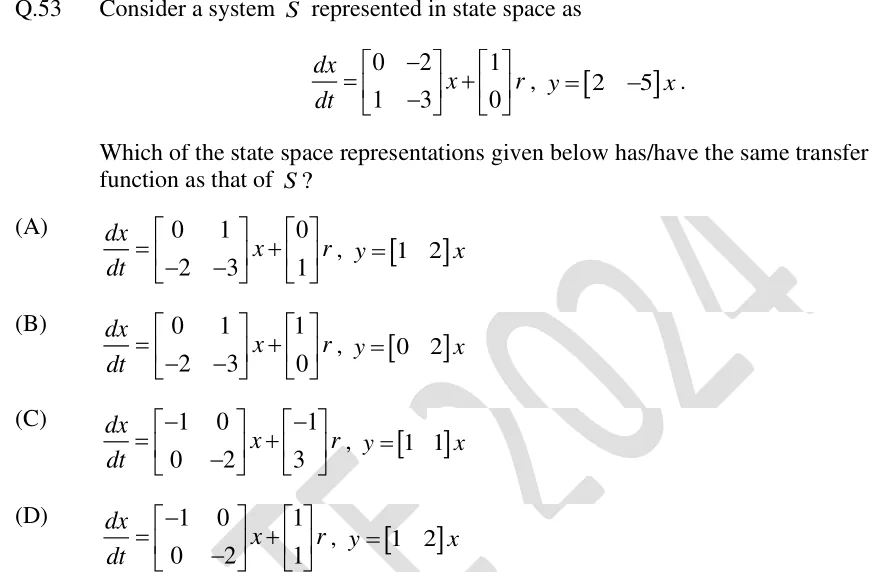
Q.53 Consider a system represented in state space as
Which of the state space representations given below has/have the same transfer function as that of ?
- (A)
- (B)
- (C)
- (D)

Q.53 Consider a system represented in state space as
Which of the state space representations given below has/have the same transfer function as that of ?
ANSWER
Options (A) and (C). Both have the same transfer function as : .
Official answer: A, CSource: Official answer key, GATE 2024 EC (IISc Bengaluru)
Transfer function of , from . Here , so and .
, so . Therefore
(A) Controllable canonical form. with , is the companion matrix of , and . For this form gives the numerator . With the numerator is , so . This matches.
(B) Same , but . Now , so and . Then , so . This does not match.
Diagonal (modal) form. When , . Expand in partial fractions. The residue at is , and the residue at is . So Check: .
(C) , , with and . So . This matches.
(D) and , so . This does not match.
All four options share the characteristic polynomial , so they all have poles at and . Only the numerators tell them apart, and only (A) and (C) give . Answer: (A) and (C).
KEY IDEA
A state-space realisation is not unique. Every option here has the same characteristic polynomial , so the poles cannot tell them apart and only the numerator can. For a controllable canonical form, read the numerator straight from (when ). For a diagonal form, compare the products with the partial-fraction residues of .
WATCH OUT FOR
Deciding on eigenvalues alone. All four options have poles at and , so that test passes every one of them. A second trap is option (B): it has the companion matrix, but is not the controllable-canonical input vector, so you cannot read the numerator off . Its actual transfer function is . In the diagonal forms, only the products matter, not or on their own. That is why (C) matches even though its looks nothing like the original.
From the GATE 2024 EC paper. Every question of this paper · Download the full paper · All 16 State space questions, with notes