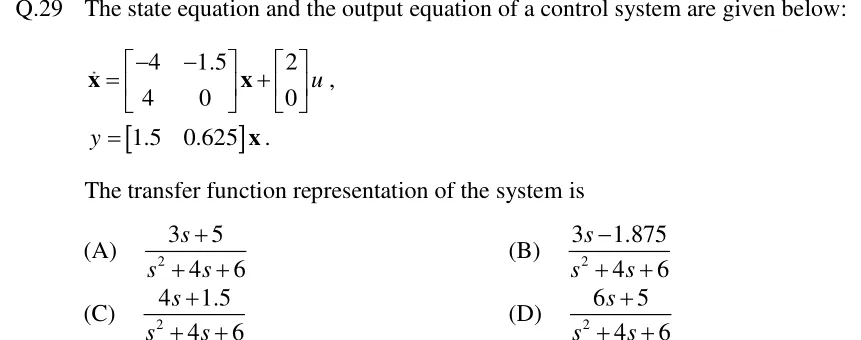
The state equation and the output equation of a control system are given below:
The transfer function representation of the system is
- (A)
- (B)
- (C)
- (D)

The state equation and the output equation of a control system are given below:
The transfer function representation of the system is
ANSWER
The transfer function is , which is option (A).
Official answer: ASource: Official answer key, GATE 2018 EC (IIT Guwahati)
With no direct feed-through term (), the transfer function is .
, so . This is the characteristic polynomial. All four options have this denominator, so the numerator decides the answer.
To get the adjugate of a matrix, swap the diagonal entries and change the sign of the off-diagonal ones: .
.
Numerator: .
Two quick checks. (i) The leading numerator coefficient of a strictly proper second-order is . That rules out (C), which has 4, and (D), which has 6. (ii) DC gain: . Here and , so and . That matches for (A) and rules out (B), whose is negative. Only (A) passes both checks.
KEY IDEA
For a state model with , . The denominator is . For a system, you get the numerator by multiplying . When every option has the same denominator, two shortcuts settle it with no inversion: the -coefficient of the numerator equals , and the DC gain equals .
WATCH OUT FOR
Sign errors when forming : the off-diagonal entries flip sign, giving and . Sign errors also happen in the adjugate, where the off-diagonal entries are negated. Get either wrong and you end up with a numerator like (option B). Another mistake is multiplying and against instead of its adjugate or inverse. Also note that the DC-gain check alone cannot tell (A) from (D), because both have . You also need the leading coefficient .
From the GATE 2018 EC paper. Every question of this paper · Download the full paper · All 16 State space questions, with notes