
IAE Academy

GATE 2025 IN Q.28: solution and answer

GATE 2025 · INQ.28 · 1 mark · MCQ

Consider the control system block diagram given in Figure (a). The loop transfer function does not have any pole on the -axis. The counterclockwise contour with infinite radius, as shown in Figure (b), encircles two poles of . Choose the correct statement from the following options for closed loop stability of the system.
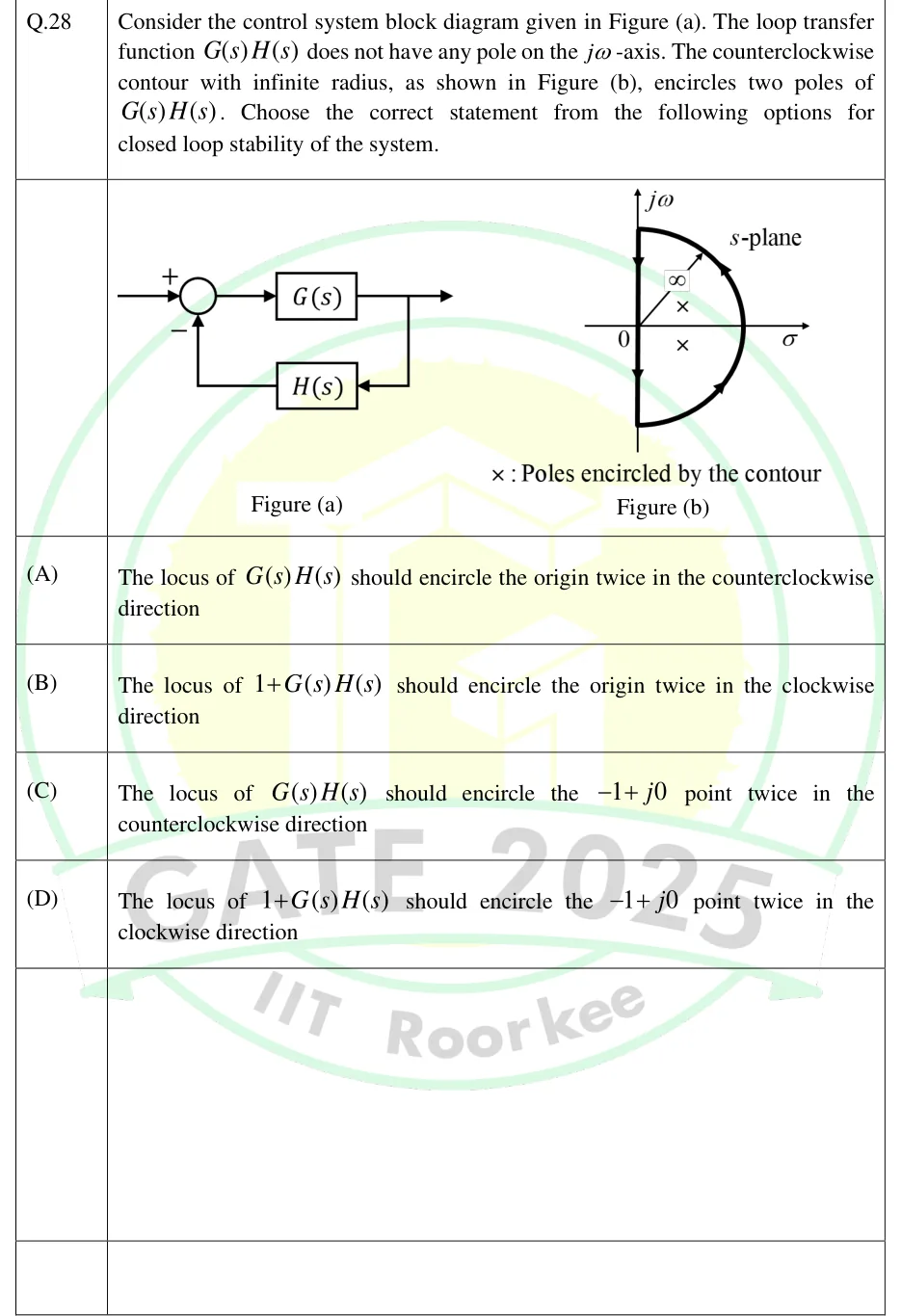
GATE 2025 IN question 28: Figure (a): negative-feedback loop.Tap to open full size
Figure from the GATE 2025 IN paper. It is part of the question.
Figure description

Figure (a): negative-feedback loop. Input enters a summing junction with sign +; the junction output feeds block G(s), whose output is the system output (arrow to the right). The output is picked off and fed back through block H(s) (drawn below, signal flowing right to left) into the summing junction with sign −. Figure (b): s-plane with σ (horizontal) and j ω (vertical) axes, origin marked 0. A closed contour covers the right half-plane: the whole j ω -axis plus a semicircle of infinite radius (a radius line labelled ∞) on the right. Arrowheads on the semicircle point upward (from -j ∞ round through the right side to +j ∞) and arrowheads on the j ω -axis point downward (from +j ∞ to -j ∞), i.e. the contour is traversed counterclockwise. Two crosses lie inside the contour in the right half-plane, one above and one below the real axis. Legend: '×: Poles encircled by the contour'.

  1. (A)

    The locus of should encircle the origin twice in the counterclockwise direction

  2. (B)

    The locus of should encircle the origin twice in the clockwise direction

  3. (C)

    The locus of should encircle the point twice in the counterclockwise direction

  4. (D)

    The locus of should encircle the point twice in the clockwise direction

Answer and solution

ANSWER

The answer is (B). For closed-loop stability, the locus of must encircle the origin twice in the clockwise direction.

Official answer: BSource: Official answer key, GATE 2025 IN (IIT Roorkee)

  1. Closed-loop characteristic function: . Its poles are the open-loop poles, i.e. the poles of . Its zeros are the closed-loop poles.

  2. Data: the contour of infinite radius encloses the whole right half-plane and contains poles of , so also has poles inside it. No poles lie on the -axis, so the contour needs no indentation.

  3. Argument principle (the direction matters): as goes once round a closed contour, the image encircles the origin times in the same direction the contour is traversed. Here and are the zeros and poles of inside the contour.

  4. The contour in Figure (b) runs up the semicircle and down the -axis, which keeps the enclosed right half-plane on its left, so it is counterclockwise. Therefore the net number of counterclockwise encirclements of the origin by is .

  5. Closed-loop stability means no closed-loop poles in the right half-plane, i.e. :

  6. A count of counterclockwise encirclements is 2 clockwise encirclements of the origin by . Since is just shifted left by 1, this is the same as encircling twice clockwise.

  7. Check the options: (A) pairs with the origin and (D) pairs with , so both use the wrong critical point. (C) is the textbook rule for the usual clockwise Nyquist contour, and it gets the direction backwards for the counterclockwise contour drawn here. Only (B) is correct.

KEY IDEA

The argument principle counts encirclements in the same direction as the s-plane contour is traversed. This contour is counterclockwise, so the counterclockwise encirclements of the origin by number . Stability needs , and with that gives counterclockwise encirclements, which is 2 clockwise ones. For the critical point is the origin, and for it is .

WATCH OUT FOR

Picking (C) by habit. The memorised rule 'P counterclockwise encirclements of ' assumes the usual clockwise Nyquist contour. The contour here is counterclockwise, so every encirclement direction flips. A second trap is using the wrong critical point: goes with and the origin goes with . That rules out (A) and (D).

From the GATE 2025 IN paper. Every question of this paper · Download the full paper · All 11 Nyquist questions, with notes

More Nyquist questions