IAE Academy

GATE 2026 CS1 Q.44: solution and answer

GATE 2026 · CS1Q.44 · 2 marks · MCQ

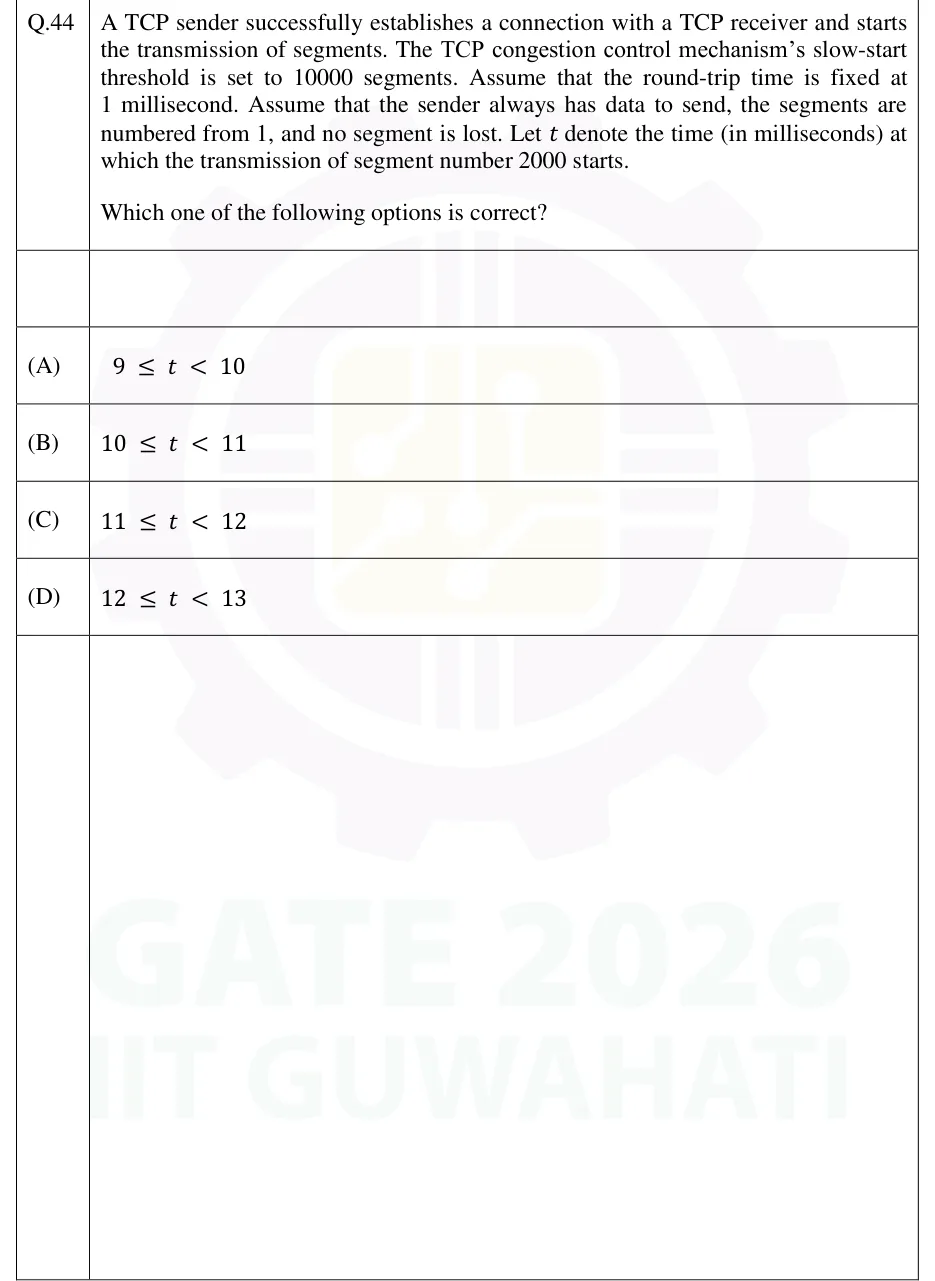
A TCP sender successfully establishes a connection with a TCP receiver and starts the transmission of segments. The TCP congestion control mechanism's slow-start threshold is set to 10000 segments. Assume that the round-trip time is fixed at 1 millisecond. Assume that the sender always has data to send, the segments are numbered from 1, and no segment is lost. Let t denote the time (in milliseconds) at which the transmission of segment number 2000 starts.

Which one of the following options is correct?

  1. (A)

    9 \le t < 10

  2. (B)

    10 \le t < 11

  3. (C)

    11 \le t < 12

  4. (D)

    12 \le t < 13

See the question in the paper

Answer and solution

ANSWER

Option (B): 10 ≤ t < 11

Official answer: BSource: Official answer key, GATE 2026 CS1 (IIT Guwahati)

  1. The threshold is 10000 segments, far above 2000, so the sender stays in slow start. With no loss, the congestion window starts at 1 MSS and doubles every round-trip time (RTT = 1 ms).

  2. Take round (for ) to begin at ms. It sends segments.

  3. Segments sent in rounds to in total: .

  4. After round 10, segments have been sent. The window in round 11 is , so it is still slow start.

  5. Segment 2000 satisfies , so it is sent in round 11, which begins at ms.

  6. The segments of round 11 go out as ACKs return during that one RTT, before round 12 begins at ms. Hence , which is option (B).

KEY IDEA

In slow start with no loss the window doubles each RTT, so round k sends 2^(k-1) segments and the first k rounds send 2^k - 1 in total. Find the round containing segment 2000, then read its start time.

WATCH OUT FOR

Being off by one round. Segment 1 goes out in round 1 at t = 0, so round k starts at (k-1) ms, not k ms. Using 2^k instead of 2^k - 1 for the cumulative count also shifts the answer to the wrong interval.

From the GATE 2026 CS1 paper. Every question of this paper · Download the full paper · All 12 TCP questions, with notes

More TCP questions