IAE Academy

GATE 2025 CS2 Q.16: solution and answer

GATE 2025 · CS2Q.16 · 1 mark · MCQ

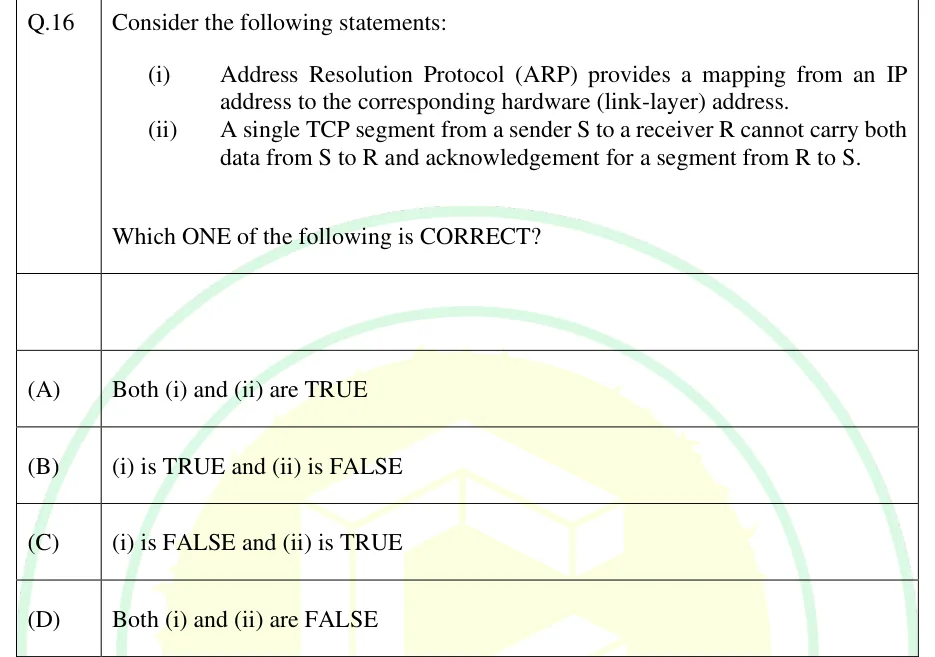
Consider the following statements:
(i) Address Resolution Protocol (ARP) provides a mapping from an IP address to the corresponding hardware (link-layer) address.
(ii) A single TCP segment from a sender S to a receiver R cannot carry both data from S to R and acknowledgement for a segment from R to S.

Which ONE of the following is CORRECT?

  1. (A)

    Both (i) and (ii) are TRUE

  2. (B)

    (i) is TRUE and (ii) is FALSE

  3. (C)

    (i) is FALSE and (ii) is TRUE

  4. (D)

    Both (i) and (ii) are FALSE

See the question in the paper

Answer and solution

ANSWER

Option (B): statement (i) is true and statement (ii) is false.

Official answer: BSource: Official answer key, GATE 2025 CS2 (IIT Roorkee)

  1. Statement (i): ARP takes a known IP address and finds the hardware (MAC, link-layer) address of the host on the same network. So (i) is TRUE.

  2. Statement (ii): TCP is full duplex. Every TCP header has a sequence number, an acknowledgement number, an ACK flag and room for a payload.

  3. A segment sent from R to S that carries R's own data can also set the ACK flag and acknowledge the data received from S. This is called piggybacking, so one segment can carry both data and an acknowledgement.

  4. Statement (ii) says this cannot happen, so (ii) is FALSE.

  5. (i) is TRUE and (ii) is FALSE, which is option (B).

KEY IDEA

ARP maps an IP address to a link-layer address. TCP piggybacks acknowledgements on data segments, because every TCP segment has an acknowledgement field.

WATCH OUT FOR

Thinking ARP maps a hardware address to an IP address (that is the job of RARP). Also thinking a TCP segment is either data or an acknowledgement, never both.

From the GATE 2025 CS2 paper. Every question of this paper · Download the full paper · All 12 TCP questions, with notes

More TCP questions