
IAE Academy

GATE 2026 CS2 Q.65: solution and answer

GATE 2026 · CS2Q.65 · 2 marks · NAT

It is necessary to design a link-layer protocol between two hosts that are directly connected over a lossless link of length 3000 kilometers. Assume that the link bandwidth is bits per second and that the propagation delay in the link is 5 nanoseconds per meter. Every transmitted data byte is assigned a unique sequence number.

Let be the minimum number of bits needed for the sequence number field in the protocol header such that

i. the sequence numbers do not wrap around before 60 seconds, and
ii. the maximum utilization of the link is achieved.

The value of is ______. (answer in integer)
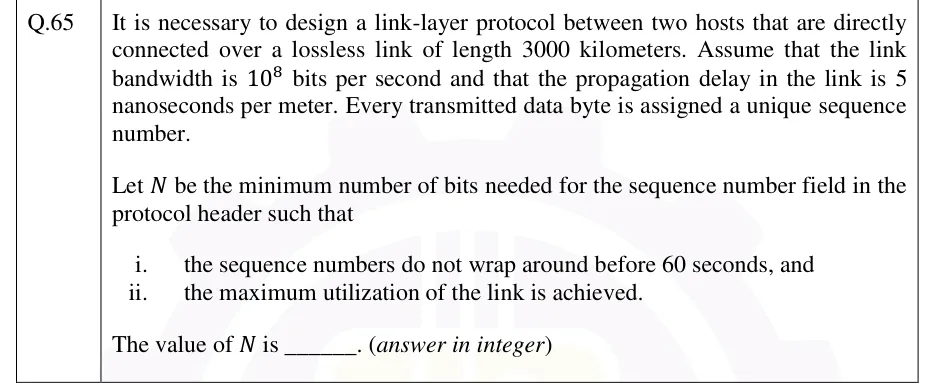
See the question in the paper

Answer and solution

ANSWER

N = 30

Official answer: 30Source: Official answer key, GATE 2026 CS2 (IIT Guwahati)

  1. Propagation delay: , so and .

  2. Condition ii (maximum utilization): the sender must keep the pipe full for one RTT, so the window is the bandwidth-delay product: .

  3. Every byte has its own sequence number, so the sequence space must cover this window. Even with selective repeat (which needs numbers): , so condition ii needs at most 20 bits. (Go-Back-N needs , i.e. 19 bits.)

  4. Condition i (no wrap-around in 60 s): at full rate the link carries bytes per second, so in 60 s the sender uses up to sequence numbers.

  5. We need . Since and , we get .

  6. Condition i (30 bits) is stricter than condition ii (at most 20 bits), and 30 bits satisfies both. Hence .

KEY IDEA

Two conditions give two lower bounds on the sequence-number size: the window (bandwidth-delay product) fixes one, and the number of bytes sent at full rate in 60 s fixes the other. Take the larger.

WATCH OUT FOR

Using only the bandwidth-delay product (about 19 or 20 bits) and forgetting that, with one sequence number per byte, 60 s of full-rate sending uses numbers. Another slip is counting bits instead of bytes when sizing the sequence space.

From the GATE 2026 CS2 paper. Every question of this paper · Download the full paper · All 7 Performance questions, with notes

More Performance questions