IAE Academy

GATE 2026 CS2 Q.21: solution and answer

GATE 2026 · CS2Q.21 · 1 mark · MCQ

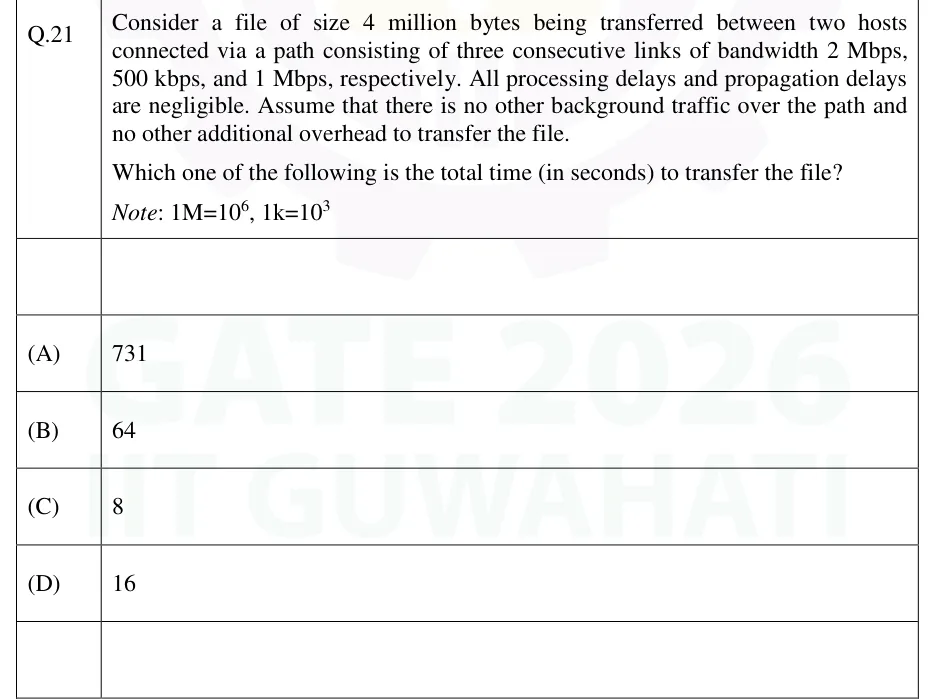
Consider a file of size 4 million bytes being transferred between two hosts connected via a path consisting of three consecutive links of bandwidth 2 Mbps, 500 kbps, and 1 Mbps, respectively. All processing delays and propagation delays are negligible. Assume that there is no other background traffic over the path and no other additional overhead to transfer the file.

Which one of the following is the total time (in seconds) to transfer the file?

Note: 1M=10^6, 1k=10^3

  1. (A)

    731

  2. (B)

    64

  3. (C)

    8

  4. (D)

    16

See the question in the paper

Answer and solution

ANSWER

The total time to transfer the file is 64 seconds, option (B).

Official answer: BSource: Official answer key, GATE 2026 CS2 (IIT Guwahati)

  1. File size in bits: .

  2. Link rates (with , ): , and bits per second.

  3. Processing and propagation delays are negligible, and there is no other traffic or overhead. The file therefore flows through the three links as one continuous stream, and the slowest link sets the end-to-end throughput.

  4. The slowest link is the link, so the end-to-end throughput is .

  5. Check: the same data would take on the first link and on the third. Both links are faster than the bottleneck and work at the same time as it, so they add nothing. The answer is option (B).

KEY IDEA

With negligible delays, no overhead and no other traffic, a file sent over several links in series is limited by the slowest link. The time is the file size in bits divided by the bottleneck rate. Do not add up the time on each link.

WATCH OUT FOR

Adding the transfer times of the three links (16 + 64 + 32 = 112 s), which treats each link as if it waited for the whole file. Other slips are forgetting to convert bytes to bits, which gives 8 s, and reading 500 kbps as 500 Mbps.

From the GATE 2026 CS2 paper. Every question of this paper · Download the full paper · All 7 Performance questions, with notes

More Performance questions