
IAE Academy

ISRO CS 2023 Q.15: solution and answer

ISRO 2023 · CSQ.15 · 1 mark · MCQ

Match the following:

Versions of 802.11: (i) 802.11ac, (ii) 802.11 a/g, (iii) 802.11 ad, (iv) 802.11 b
Speed of Wireless LAN: (P) 7 Gbps, (Q) 11 Mbps, (R) 54 Mbps, (S) 3.5 Gbps
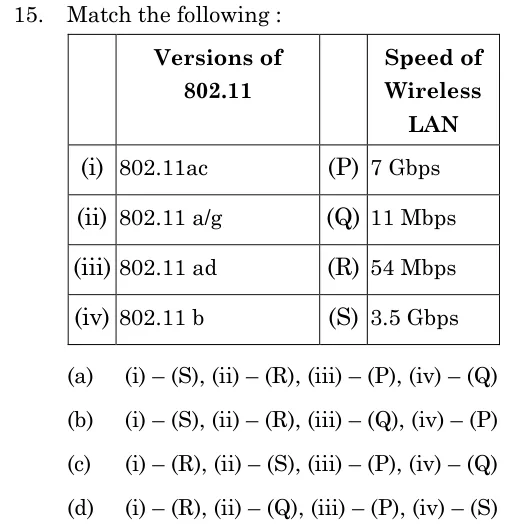
ISRO CS 2023 question 15: A two-column table.Tap to open full size
Figure from the ISRO CS 2023 paper. It is part of the question.
Figure description

A two-column table. Left column 'Versions of 802.11' lists (i) 802.11ac, (ii) 802.11 a/g, (iii) 802.11 ad, (iv) 802.11 b. Right column 'Speed of Wireless LAN' lists (P) 7 Gbps, (Q) 11 Mbps, (R) 54 Mbps, (S) 3.5 Gbps.

  1. (A)

    (i) – (S), (ii) – (R), (iii) – (P), (iv) – (Q)

  2. (B)

    (i) – (S), (ii) – (R), (iii) – (Q), (iv) – (P)

  3. (C)

    (i) – (R), (ii) – (S), (iii) – (P), (iv) – (Q)

  4. (D)

    (i) – (R), (ii) – (Q), (iii) – (P), (iv) – (S)

Answer and solution

ANSWER

Option (a): (i) - (S), (ii) - (R), (iii) - (P), (iv) - (Q).

Official answer: ASource: ISRO's revised and final answer key of 16 February 2024

  1. Recall the nominal peak data rates of the 802.11 amendments. These are standard reference values.

  2. 802.11b works in the band with DSSS/CCK and has a maximum rate of , so (iv) matches (Q).

  3. 802.11a () and 802.11g () both use OFDM with a maximum rate of , so (ii) matches (R).

  4. 802.11ad (WiGig) works in the band and reaches about , so (iii) matches (P).

  5. The only rate left is (S), . This is the figure usually quoted for 802.11ac (, wide channels, MU-MIMO), so (i) matches (S). It is also the only pairing that leaves each rate used once.

  6. The matching (i)-(S), (ii)-(R), (iii)-(P), (iv)-(Q) is option (a).

  7. Check the other options. Option (b) pairs 802.11b with and 802.11ad with . Options (c) and (d) pair 802.11ac with , which is the rate of the older 802.11a/g, so they fail.

KEY IDEA

Remember the peak rate of each 802.11 amendment: b = 11 Mbps, a/g = 54 Mbps, ac = about 3.5 Gbps in the usual textbook figure, ad = about 7 Gbps. Fix the three firm ones first and the last pair follows.

WATCH OUT FOR

Giving 802.11ac the 54 Mbps of 802.11a/g, or swapping the two gigabit standards. Treating 802.11ad as the slower one is also wrong, since it runs at 60 GHz with very wide channels.

From the ISRO CS 2023 paper. Every question of this paper · The full paper (PDF, ISRO) · All 5 ISRO Data link & MAC questions, with notes

More ISRO Data link & MAC questions