
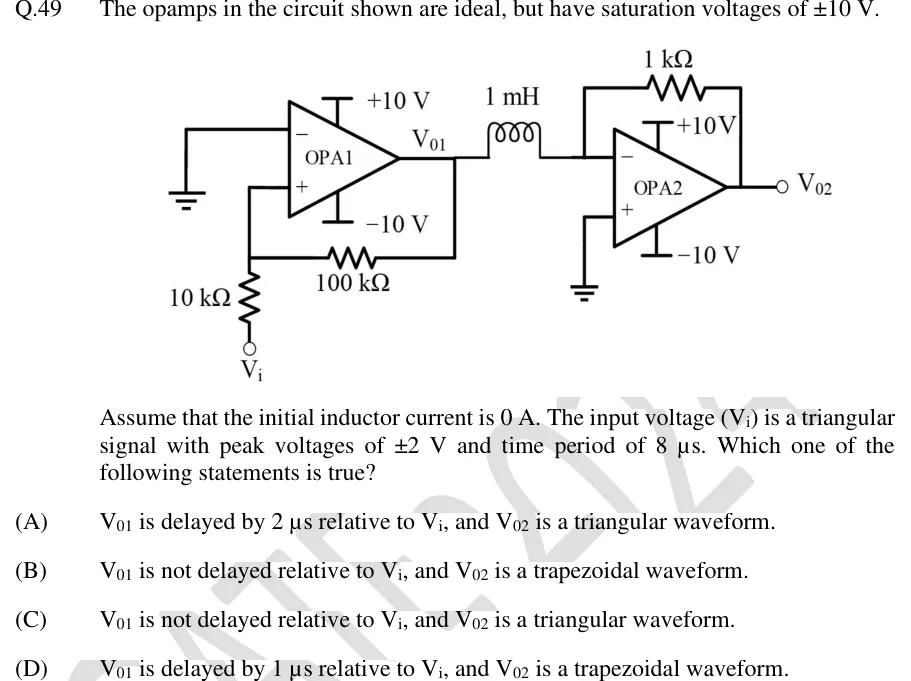
The opamps in the circuit shown are ideal, but have saturation voltages of .
[Figure]
Assume that the initial inductor current is . The input voltage () is a triangular signal with peak voltages of and time period of . Which one of the following statements is true?
 Tap to open full size
Figure description
Two op-amp stages in cascade. Stage 1 (OPA1), supplies +10 V and -10 V: its inverting (-) input is connected directly to ground. Its non-inverting (+) input is a node that connects (a) through a 10 kΩ resistor down to the input terminal V_i, and (b) through a 100 kΩ resistor to the OPA1 output, labelled V01 (positive feedback). Stage 2 (OPA2), supplies +10 V and -10 V: V01 drives a 1 mH inductor whose other end goes to the inverting (-) input of OPA2; the non-inverting (+) input of OPA2 is grounded; a 1 kΩ resistor connects the OPA2 output (terminal labelled V02) back to its inverting input.
- (A)
is delayed by relative to , and is a triangular waveform.
- (B)
is not delayed relative to , and is a trapezoidal waveform.
- (C)
is not delayed relative to , and is a triangular waveform.
- (D)
is delayed by relative to , and is a trapezoidal waveform.