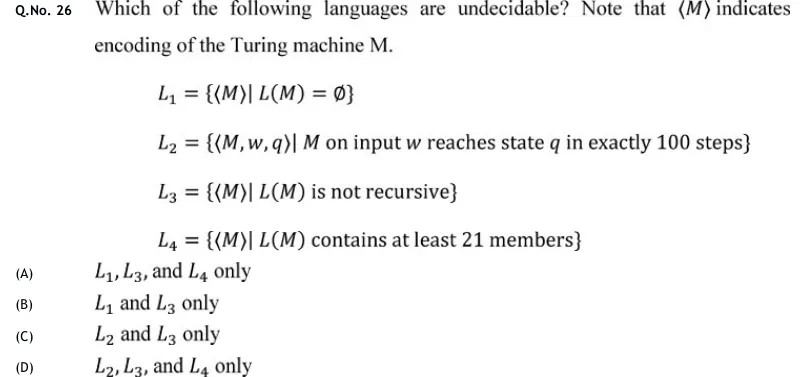
Which of the following languages are undecidable? Note that indicates encoding of the Turing machine .
- (A)
, , and only
- (B)
and only
- (C)
and only
- (D)
, , and only

Which of the following languages are undecidable? Note that indicates encoding of the Turing machine .
, , and only
and only
and only
, , and only
ANSWER
Option (A): , and are undecidable, and is decidable.
Official answer: ASource: Official answer key, GATE 2020 CS (IIT Delhi)
: whether on input reaches state in exactly 100 steps needs only a bounded simulation. Run on for 100 steps and see whether it is in state after step 100. This always halts, so is decidable.
asks about the language alone. The property is non-trivial: a machine that rejects everything has , and a machine that accepts does not. By Rice's theorem is undecidable.
also asks about alone. It is non-trivial: is recursive, so a machine that accepts nothing is not in . The halting language is recursively enumerable but not recursive, so a machine accepting is in . By Rice's theorem is undecidable.
is a property of alone. It is non-trivial: fails it and satisfies it. By Rice's theorem is undecidable.
So , and are undecidable and is decidable. The answer is option (A), , , and only.
KEY IDEA
Rice's theorem makes every non-trivial property of undecidable. A property of a bounded run of , such as exactly 100 steps, is decidable by direct simulation.
WATCH OUT FOR
Treating as undecidable because it mentions a Turing machine's run. The step bound makes it a finite simulation that always halts. Another slip is to skip because it says "not recursive", although it is still a non-trivial property of the language.
From the GATE 2020 CS paper. Every question of this paper · Download the full paper · All 8 Turing machines questions, with notes