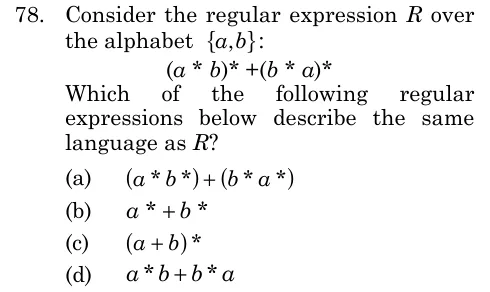
78. Consider the regular expression over the alphabet : . Which of the following regular expressions below describe the same language as ?
- (A)
- (B)
- (C)
- (D)

78. Consider the regular expression over the alphabet : . Which of the following regular expressions below describe the same language as ?
ANSWER
The expression describes all strings over , so it is equivalent to : option (C).
Official answer: CSource: ISRO's final answer key of 15 May 2026
Each part of is a star of a block. is a concatenation of blocks of the form , so every block ends in . Hence this part generates and only strings ending in .
Every nonempty string ending in is in . Cut the string just after each . Each piece is some 's followed by one , which is a block .
By symmetry, generates exactly together with all strings that end in .
Every string over is empty, ends in , or ends in . So .
Hence is equivalent to , which is option (C).
Option (A), : the string is in neither part. It is not of the form because an follows a . It is not of the form because a follows an . So (A) misses a string of .
Option (B), : the string contains both letters, so it is in neither part, yet it ends in and is in .
Option (D), : it does not generate . It also misses and . Each is in .
KEY IDEA
is plus all strings ending in , and is plus all strings ending in . Together they cover every string.
WATCH OUT FOR
Reading as strings with all 's before all 's, which gives (option A). The outer star lets the blocks repeat, so 's can follow 's.
From the ISRO CS 2025 paper. Every question of this paper · The full paper (PDF, ISRO) · All 5 ISRO Finite automata questions, with notes