ANSWER
The false statements are (B), (C) and (D).
Official answer: B, C, DSource: Official answer key, GATE 2022 CS (IIT Kharagpur)
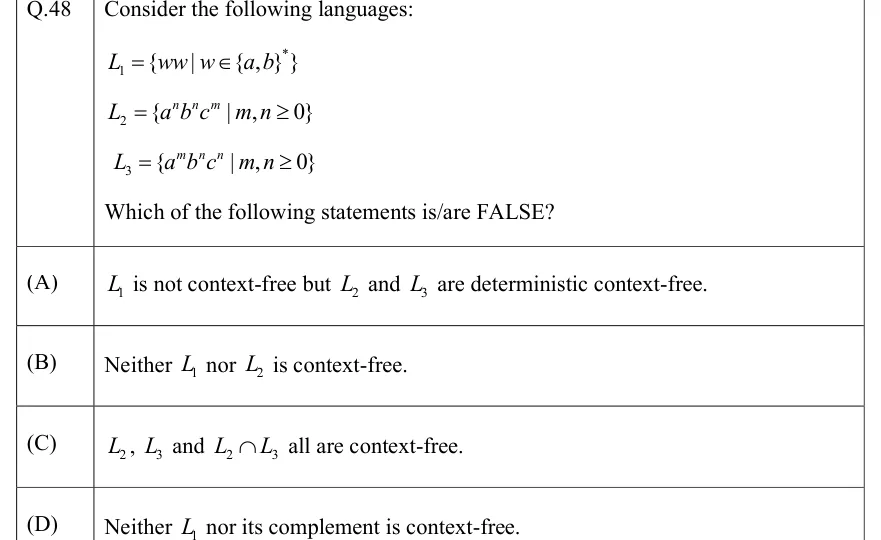
L1={ww∣w∈{a,b}∗} is the copy language. It is not context-free (pumping lemma for CFLs, or the standard result). So the first half of (A) is correct.
L2={anbncm∣m,n≥0} is accepted by a DPDA that pushes a symbol for each a, pops one for each b, then reads any number of c's and accepts on empty stack. So L2 is a deterministic context-free language. A grammar is S→XC, X→aXb∣ε, C→cC∣ε.
L3={ambncn∣m,n≥0} is accepted by a DPDA that skips the a's, pushes for each b and pops for each c. So L3 is a DCFL. Hence statement (A) is TRUE.
Statement (B) says L2 is not context-free. But L2 is context-free by step 2, so (B) is FALSE.
L2∩L3={anbncn∣n≥0}, which is not context-free (pumping lemma for CFLs). Statement (C) claims it is context-free, so (C) is FALSE.
The complement of L1 is context-free. A string over {a,b} is outside L1 if its length is odd, or if its length is 2n and some position i and position i+n hold different symbols. A PDA can guess the position, push a count while reading, and match it against the second half. This gives a CFL. Statement (D) says neither L1 nor its complement is context-free, so (D) is FALSE.
The FALSE statements are B, C and D.
KEY IDEA
L1={ww} is not context-free but its complement is. anbncm and ambncn are DCFLs, and their intersection anbncn is not context-free, so CFLs are not closed under intersection.
WATCH OUT FOR
Assuming that because {ww} is not context-free, its complement cannot be either. The complement is context-free because a PDA can guess one mismatching position. Another slip is treating L2∩L3 as context-free just because L2 and L3 are.